
The roof has to outlive the array, or the math falls apart
A solar contractor will tell you the panels last twenty-five or thirty years. They are usually right. What that conversation skips is the roof those panels are bolted to, which on a lot of Oklahoma City commercial buildings has nowhere near that much life left. We field these calls constantly from owners along the South Meridian hospitality strip, the big flex and distribution boxes off the I-240 belt, and the office parks near Will Rogers World Airport: a signed solar proposal, a generous incentive package, and a roof that nobody on the solar side actually opened up and looked at. Our role is the part everyone else assumes will take care of itself, making the roof and the array work as one system instead of two scopes that collide a year later.
Why a core sample comes before a panel layout
The costliest error in rooftop solar around here is mounting an array on a membrane with single-digit years remaining. When that roof finally gives out, the panels, racking, and wiring all come off, the new roof goes down, and the whole array gets reinstalled. That detach-and-reset cycle routinely lands in the tens of thousands of dollars and was entirely preventable. So we cut cores into the existing assembly, pull fasteners to check holding power, look at seam condition, and hand the owner a straight remaining-life figure. Fifteen-plus good years and mounting on what is there makes sense. Down near the end of the curve and re-roofing first wins almost every time, because you pay for one roof and one array installation instead of two of each.
Ballast or penetration is a wind question first
There are two basic ways to keep an array on a low-slope Oklahoma City roof, and in this part of the country the deciding factor is wind before anything else. Ballasted racking rides on weighted trays and never breaks the membrane, attractive on paper because there is nothing to leak, but it leans entirely on dead weight to resist uplift. Penetrating racking anchors through the roof into the deck or structure, holds far better against wind, and creates a flashed roof opening at every foot. Oklahoma City sits in one of the more active severe-weather corridors in the country, where straight-line gusts and hail events are a normal part of the calendar, so on plenty of buildings here a purely ballasted array simply will not stay put in a strong storm. A mechanically attached or hybrid system becomes the honest recommendation, and we make that call against both the exposure and what the deck can take.
Dead load and uplift belong to an engineer, not a hunch
The warehouses and older masonry buildings around the Stockyards and the Farmers Market district were framed long before anyone pictured panels on the roof. Full ballast can stack several pounds per square foot across the entire deck, and uplift does not spread evenly, it spikes hardest at the corners and along the perimeter where wind pressure concentrates. We refuse to eyeball this. The proposed array layout and attachment scheme get run against the building's real structural capacity by a licensed engineer, and we surface that requirement at the very start so a structural reinforcement does not ambush the budget midway through. Answering the weight-and-uplift question before mobilization is exactly what keeps panels on the roof through the next round of warnings on the radar.
Treat every penetration like the leak it wants to become
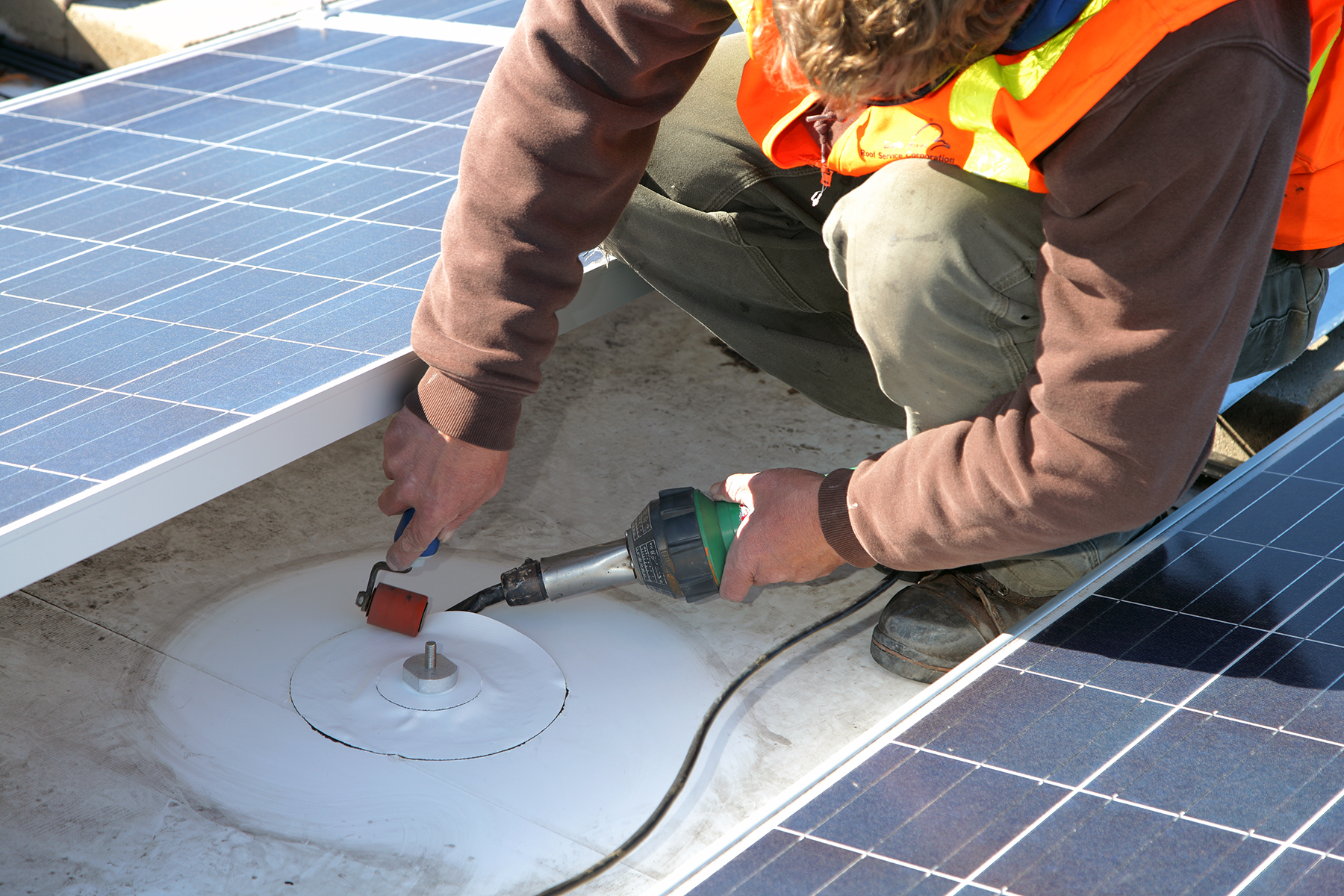
A penetrating rack can drive dozens of feet through a membrane, and each one earns the same flashing standard as any rooftop penetration: a proper base flashing, the manufacturer's approved detail, and a watertight termination. The DC conduit running power from the array back to the electrical room deserves the same respect. Conduit strapped flat against the membrane saws into the sheet as both expand and contract under the Oklahoma sun, and conduit shoved through a generic boot turns into a slow, recurring leak. We carry conduit on approved standoff supports and flash every conduit penetration as roofing work, never as something the electrician handles on the way out. The sequence is non-negotiable, membrane and flashings go down and get inspected before the solar crew runs the first home run.
What membrane goes under the panels
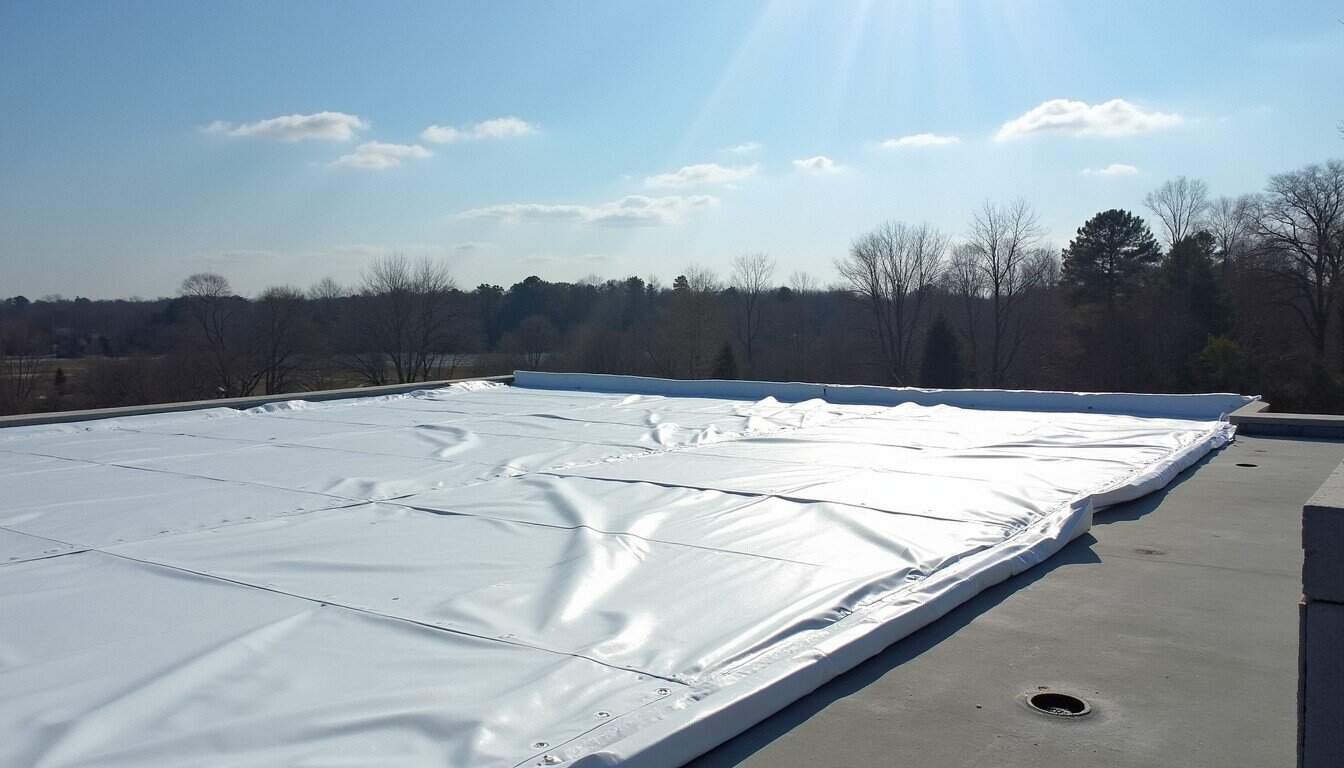
The roof spec beneath an array is its own decision and not an afterthought. A reflective white TPO or PVC system is the usual pick in this climate because the light surface stays cooler under the modules and a mechanically attached sheet gives racking a stable, even base to land on. Where the structure limits how much ballast it can carry, a fully adhered assembly earns its place. And walk pads have to be drawn in along every path a solar technician will use, because foot traffic between module rows is the leading cause of in-service membrane damage on any solar roof. We spec the assembly to cooperate with the array instead of fighting it.
Two warranties, and how we keep both alive
This is where solar jobs quietly come apart. The membrane manufacturer warranties the roof; the solar EPC warranties the array. Most major single-ply manufacturers will permit panels on a warranted roof, but only when the attachment details, the walkway protection, and the penetration flashings follow their published program and their field representative signs off on the plan first. Skip that review, and the owner is left with an array sitting on a roof whose warranty no longer means anything. We run the manufacturer's pre-installation review, document every approved detail, and meet with the solar contractor before anyone mobilizes to nail down the choreography: who flashes which penetrations, where conduit travels, and what each party has to submit to register its own warranty. We do not sell or install panels. Our entire job is protecting the roof and keeping both warranties enforceable after the array is energized.
Where Oklahoma City economics enter the picture
Commercial solar pencils out in this market on the federal Investment Tax Credit, accelerated depreciation, and the relief it gives against the demand charges that punish large OG&E accounts through the long cooling season. None of those incentives rewrite the roofing reality underneath them. A perfectly sized array on a worn-out roof is still a bad decision wearing a good spreadsheet. We help owners fold the actual condition of their roof into the payback model, so the capital plan treats the roof and the array as one project rather than two surprises discovered at different times.
Questions Oklahoma City owners ask about solar roof integration
Re-roof first, or mount on what we already have?
It comes down to remaining membrane life and nothing else. Fifteen or more documented years and mounting on the existing roof is fine. Seven or fewer and re-roofing first almost always wins, because detaching and resetting the array during a future tear-off costs more than doing the roof now and setting the panels a single time. We core the assembly and give you a service-life number before you sign anything.
Do the mounts have to puncture the membrane?
Not necessarily. Ballasted racking holds the array with weighted trays and never pierces the sheet. But given the wind and hail exposure across the Oklahoma City metro, a lot of roofs can't resist uplift on ballast alone, which pushes us toward a mechanically attached or hybrid system. When we do penetrate, every anchor is flashed to the manufacturer's detail and stays inside the roof warranty.
Will adding panels void our roof warranty?
It can, if the array goes up without the manufacturer in the loop. We schedule the manufacturer's pre-installation review, use only approved attachment and flashing details, and document the whole job so the membrane warranty survives the installation.
Who is responsible for the conduit penetrations?
We are. Conduit penetrations are roofing details, our crew flashes them before the electrician pulls wire, and the conduit rides on approved standoffs so it never grinds against the membrane.
How do you deal with the load on an older building?
Arrays add dead load from ballast and concentrate uplift at the corners and perimeter. On older buildings near the Stockyards and Farmers Market we have the layout and attachment plan reviewed by a structural engineer before installation, and we raise any capacity concern early so it lands in the budget instead of stalling the job halfway through.
Start with a roof walk.
Send the building address, roof concern, and timing. We will help define the next step.
Contact Us