
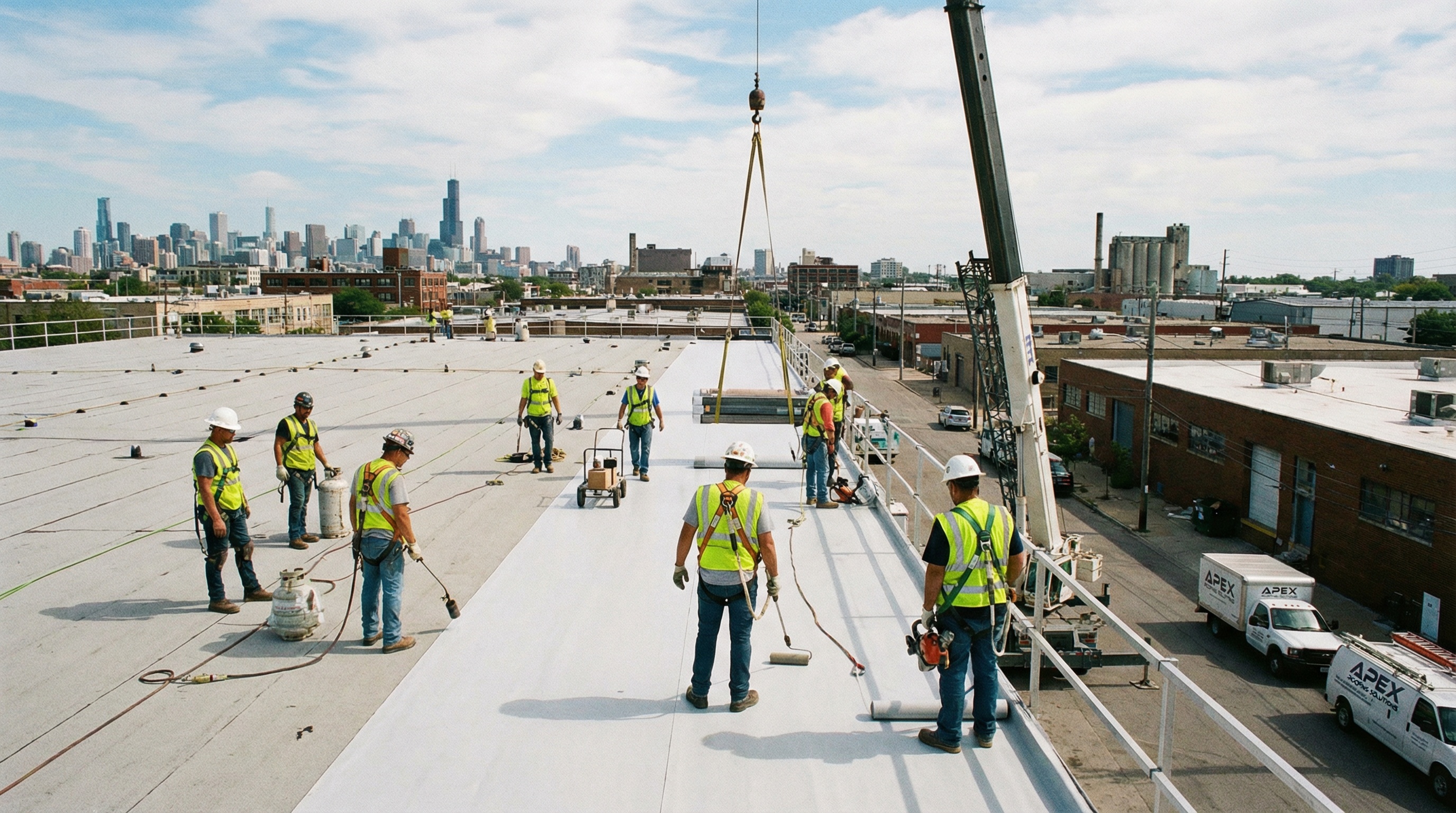
Replacement Vs Recover Analysis in Oklahoma City, OK.
The Five-Part Decision Framework for OKC Buildings
Part 1, Moisture distribution: We core the existing roof system at a density of one core per 2,000-3,000 sq ft, with additional cores at all reported leak locations, at drain fields, at parapet-adjacent zones, and at any area where an infrared scan identified suspected saturation. Each core is measured with a calibrated moisture meter and photographed. If more than 20-25% of total roof area reads wet, replacement is the correct scope, recovering wet insulation traps the moisture and voids the new warranty. Between 20-25%, the distribution pattern determines whether a selective recover with targeted insulation replacement at wet areas is the right approach.
Part 2, Post-hail cover board and insulation condition: Oklahoma City's hail frequency creates a condition that is not adequately addressed by moisture survey alone. Hail impact compresses the cover board and the top layer of polyiso insulation beneath the membrane even where the membrane surface appears intact or shows only cosmetic dimpling. Compressed insulation creates low points that accumulate water and void the recover path without showing wet on a moisture meter. We pull inspection cores and cut panels at hail-suspect areas, referenced against NOAA storm records and any prior claim documentation, before finalizing the recover recommendation.
Part 3, Deck condition: Wet insulation that has been saturated for an extended period eventually compromises the deck. On Oklahoma City's predominantly metal-deck commercial construction, we pull inspection ports at wet core locations and at any visible deck deflection points. Corroded metal deck at drain sumps and parapet-adjacent zones, the two locations where water channels most consistently in this climate, fails the recover path regardless of moisture distribution in the insulation field. Corroded deck requires replacement before any new roofing system is installed.
Part 4, Warranty status: An active manufacturer warranty on the existing system is a material factor in the recover decision. Some manufacturers offer warranty term credit toward a new manufacturer warranty when the existing system is still in-warranty at recover time, we document the existing warranty status, remaining term, and the applicable manufacturer's stated recover-warranty eligibility policy. The warranty credit, if available, changes the financial comparison between recover and replace.
Part 5, Capital horizon: Recover extends asset life typically 10-15 years depending on the recover system. The capital horizon analysis asks when the owner plans to sell, refinance, or schedule the next major capital event. If the horizon is seven years, a recover that extends asset life 12 years is the right call. If the horizon is 20 years and a recover needs replacement in year 14, a full replacement now may be more capital-efficient than two events within the same planning window.
Post-Tornado Replacement-vs-Recover Considerations
Buildings that sustained documented damage in Oklahoma's major tornado events, the May 3, 1999 Moore EF-5, the May 20, 2013 Moore EF-5, the May 31, 2013 El Reno EF-5, or subsequent severe events, sometimes have structural damage at parapet-to-deck connections, expansion joints, and roof-to-wall transitions that makes a recover scope inadequate even where the moisture survey reads dry. Post-tornado structural movement at these connections allows water infiltration that does not saturate insulation across a broad area but concentrates at structural transition points. We assess these buildings with additional attention to structural detail conditions before issuing a recover recommendation.
For insurance purposes, Oklahoma property policies under OK Title 36 insurance code require documentation distinguishing storm-caused damage from ordinary wear and deterioration when a claim is filed after a tornado or hail event. Our replacement-vs-recover report is formatted to serve as the technical basis for this distinction, the condition documentation and causation analysis can be used directly by the property insurer's adjuster without requiring a separate field inspection.
What the Written Report Contains
Core log: Core location on the roof zone diagram, layer description (membrane, cover board, insulation type and thickness, any prior recover layers, vapor barrier, deck type), moisture reading at each layer, and photograph of each core. The core log is the primary data source for the moisture distribution assessment and the document a manufacturer needs to evaluate recover-warranty eligibility.
Post-hail assessment: Inspection port findings and photographs at hail-suspect areas, correlated with NOAA storm records and prior claim documentation if available. Any insulation compression condition that affects the recover recommendation is documented explicitly.
Deck condition summary: Inspection port findings at wet-core and deflection locations, with a map of locations assessed. Conditions that affect the recover recommendation are called out with photographs and a description of the corrective scope required.
Warranty status documentation: Existing warranty document, remaining term, manufacturer's recover-warranty policy, and any warranty credit eligibility under the manufacturer's current program.
Recommendation and rationale: A clear written recommendation, recover, selective recover, or full replacement, with the specific data points that drive it. Where the data supports a borderline case, we present both options and the factors that would tip the decision, and let the owner make the call with full information.
Preliminary cost comparison: Installed cost range for the applicable recover option versus full replacement at current Oklahoma City market pricing.
Frequently asked questions
How many cores do you pull on a typical Oklahoma City commercial building?
One core per 2,000-3,000 sq ft of roof area as a baseline, plus additional cores at all reported leak locations, drain fields, parapet-adjacent zones, and any area where an infrared scan indicated suspected saturation. On a 100,000 sq ft building, we typically pull 35-50 cores. We also cut inspection panels at hail-suspect areas that may not read wet on a moisture meter but show cover board compression. The core log and panel findings are delivered with every report.
Can we recover if part of the roof is wet?
Yes, in many cases. If wet areas are concentrated under 20-25% of total area, a selective recover, remove and replace wet insulation at those areas, recover over dry areas, often works. We call this a selective recover scope and have executed it on OKC buildings where full replacement was not warranted by the moisture distribution. The selective recover increases cost slightly relative to a full-area recover but avoids the full replacement capital. We model the cost comparison in the report.
Does Oklahoma's hail history make recovers riskier than in other markets?
It adds a cover board and insulation compression assessment step that markets with lower hail frequency do not require. A building that reads dry on moisture survey but has hail-compressed polyiso creates low-point ponding under the recover system that appears within one to two post-recover seasons. We assess for compression evidence at hail-suspect areas before recommending the recover path, the additional inspection step is what makes the OKC recover recommendation defensible.
How long does the replacement-vs-recover assessment take?
Site visit for core pulls, panel cuts, and deck inspection: one day for a building up to 150,000 sq ft. Additional time if an infrared scan is included (recommended for buildings with multiple reported leak locations across a wide area). Report delivery: five business days from site visit. We provide a time estimate before scheduling.
Next StepFacing the recover-or-replace decision on an Oklahoma City commercial building?
We will pull moisture cores, assess post-hail cover board condition, inspect the deck, document warranty status, and deliver a written recommendation your capital committee can act on, with the data clearly attached.
Request a Recover-vs-Replace Assessment →
Start with a roof walk.
Send the building address, roof concern, and timing. We will help define the next step.
Contact Us