
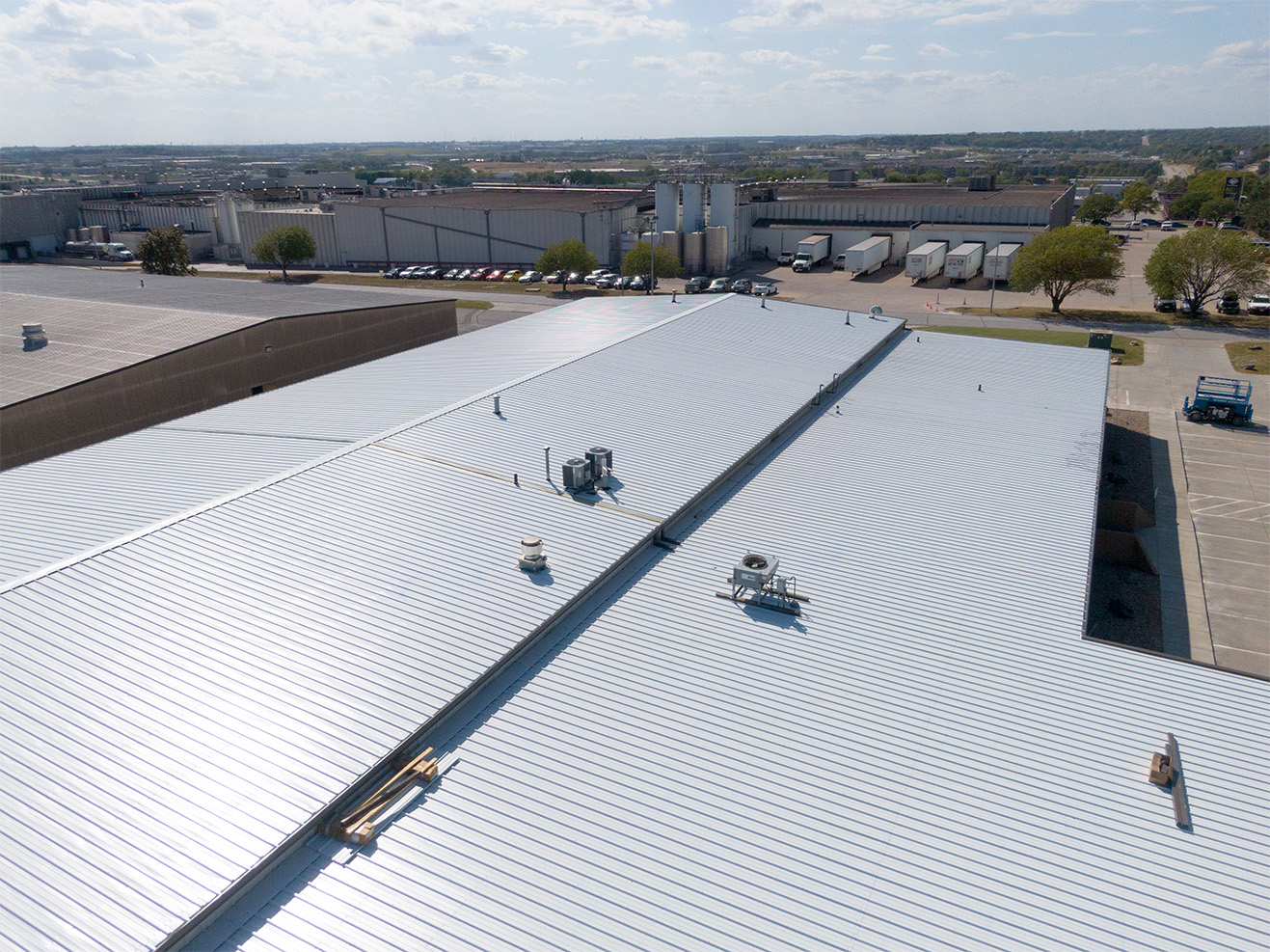
Material Specification, 24-Gauge Steel vs Aluminum for OKC Conditions
24-gauge Galvalume steel is our standard material specification for Oklahoma City commercial standing seam work. It provides the structural stiffness needed for the wider panel spans common on commercial buildings, handles the wind-uplift loads calculated for OKC's exposure categories, and carries manufacturer warranties of 40 years and more when installed with compatible sealants and fasteners. The Galvalume coating resists Oklahoma's combination of UV load, summer humidity, and the alkaline red clay dust that accumulates on commercial rooftops.
Aluminum panels are specified on coastal or chemical-exposure applications where galvanic corrosion from dissimilar metals is a concern, that situation is less common in Oklahoma's inland environment than in coastal markets. On OKC commercial projects where architectural finish or color is a priority, aluminum's paint adhesion and thermal movement characteristics can drive the specification over steel. We evaluate the structural implications of aluminum's lower modulus before finalizing any aluminum panel specification on a building with long rafter spans.
Wind-Uplift Engineering for Standing Seam in Tornado Alley
The clip pattern in a standing seam system is the structural element that resists wind-uplift load, the panel seam transfers load to the clip, the clip transfers load to the deck. For OKC commercial buildings, we design the clip pattern against the building-specific wind-uplift calculation under ASCE 7-22, not a generic table. Corner zones, eave conditions, and buildings in open terrain west of I-44 routinely require clip spacings significantly tighter than a sheltered site would need.
Edge and eave conditions are specified to FM 4435 and ANSI/SPRI ES-1 standards. These are the same edge-metal standards we apply to single-ply systems, FM-rated steel eave trim with documented uplift capacity, installed and documented in the project closeout file. Generic aluminum eave trim that meets only minimum code requirements is not adequate for OKC's tornado-alley wind exposure, and we do not specify it.
Penetration Detailing and Long-Term Maintenance
Penetrations through standing seam metal, HVAC curbs, pipe boots, skylights, exhaust equipment, are the most common leak sources on aging metal roofs in the OKC area. Thermal expansion in Oklahoma's extreme temperature range (summer surface temperatures above 160°F, winter lows below 15°F) cycles the panel around every fixed penetration. We specify only flexible pipe boots and curb flashings designed for the thermal movement of the panel material, and we document every penetration detail in the project closeout.
Annual inspection of penetrations, sealants at panel terminations, and eave trim clips is part of the maintenance program we recommend for every standing seam installation in OKC. The inspection cycle protects the manufacturer warranty and catches thermal-movement failures at penetrations before they become leak events.
Frequently asked questions
Is standing seam metal the right choice for my OKC commercial building?
It depends on slope and budget. Standing seam requires a minimum 2:12 slope and carries a higher installed cost than membrane systems. Where it earns that premium is design life, a properly specified 24-gauge Galvalume system on an OKC commercial building is engineered for 40+ years with minimal maintenance, compared to 20 to 25 years for a single-ply membrane system. For building owners making a generational capital decision, the lifecycle math often favors metal.
How does standing seam perform in OKC hail events?
24-gauge steel panels resist most hail stones without breach, the panel may dent under large hail (2.5 inches and above), but denting does not create a leak path. The vulnerable points in a hail event are the penetrations and sealants, not the panel field. Our maintenance program includes a post-storm penetration inspection after documented OKC hail events.
Can standing seam be installed over an existing roof?
Yes, a retrofit standing seam system over an existing membrane roof is a valid approach for buildings where tear-off is expensive or logistically difficult. The existing roof acts as the underlayment; the new metal system carries the wind-uplift and weather load. We assess the existing roof condition, structural capacity for the added dead load, and wind-uplift transfer path before specifying a retrofit system.
Next StepEvaluating standing seam metal for an OKC commercial building?
We assess slope, structural capacity, wind-uplift exposure, and budget, then produce a written specification with material selection, clip-pattern design documentation, and a lifecycle cost comparison against membrane alternatives.
Request a Metal Roof Scope →
Start with a roof walk.
Send the building address, roof concern, and timing. We will help define the next step.
Contact Us