
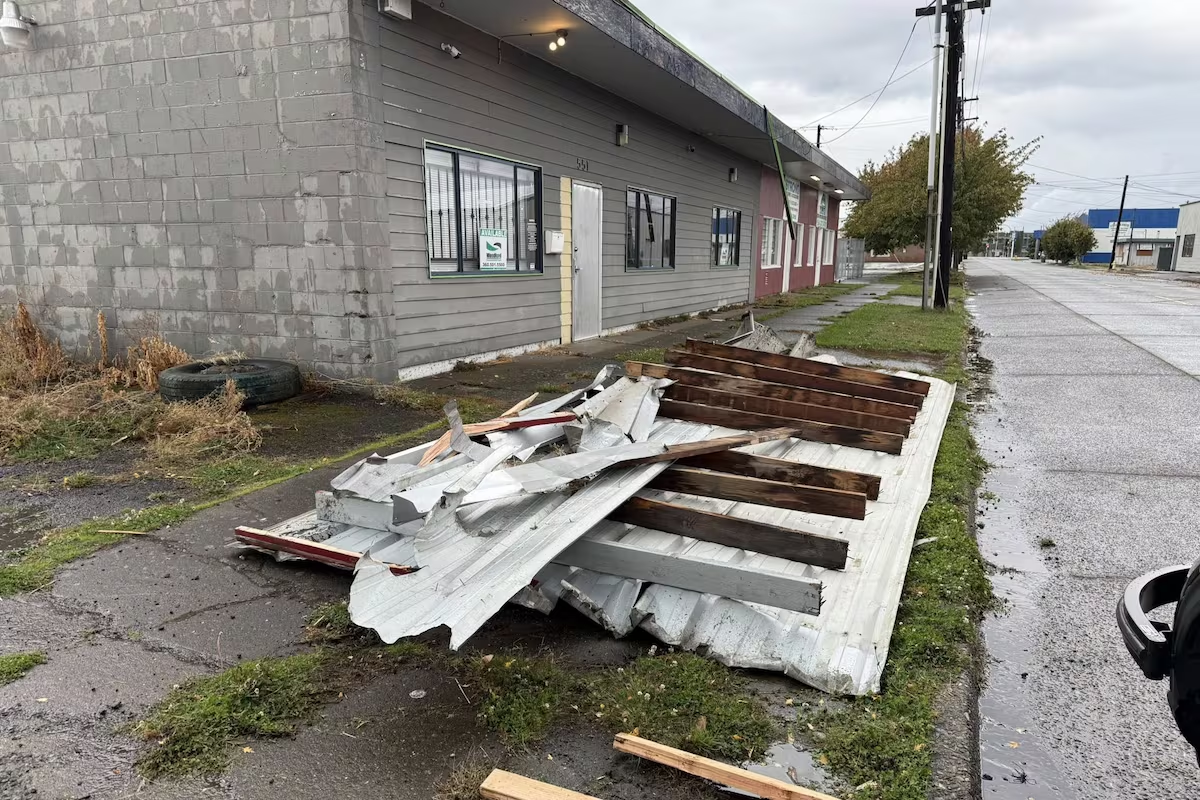
What Tornado-Track Damage Looks Like on a Flat Roof
The most common commercial roof failure in tornado-adjacent events is not catastrophic membrane removal, it is uplift-driven edge failure and parapet separation at buildings that were not in the center of the vortex but were in the rotating outer circulation. Corner zone membrane that lifted and partially re-seated looks intact from below but is no longer bonded at the perimeter termination. Parapet coping that shifted a quarter inch under the uplift load has broken the through-wall flashing bond and will admit water at every rain event until it is redetailed. These failures are structurally subtle and visually easy to miss on a post-event walk that focuses on the most dramatic damage.
Deck-to-structure connection loss is the failure mode specific to OKC's older commercial inventory. On buildings constructed before 1990 on light-gauge metal deck, the deck-to-structure connections were often designed for gravity load only, not uplift. When an extreme wind event loads those connections in uplift, the deck can separate from the structural frame in sections. Once the deck has separated, the membrane above it is unsupported and the entire roof section is effectively failed even if it looks attached. We identify deck-to-structure connection condition on every pre-1990 building we assess after a tornado event, using deck inspection ports at identified deflection points and suspected separation zones.
Parapet separation at the wall-to-deck joint is the third common failure pattern from the 1999 and 2013 event investigations. Standard manufacturer parapet flashings are designed for code wind loads, they are not engineered for the sustained uplift generated at building corners in a tornado outer circulation. We inspect parapet-to-wall flashing bonds on every tornado-track assessment and note any separation, cracking, or displacement that indicates the flashing bond was stressed beyond its design limit.
Post-Tornado Emergency Assessment and Dry-In
After a confirmed tornado track, the first 72 hours are critical for commercial buildings in the affected area. Water infiltration through a compromised roof envelope causes interior damage, to tenant improvements, equipment, inventory, and building systems, that frequently exceeds the cost of the original roof damage. We provide rapid post-tornado condition assessments for commercial buildings in our OKC service area: documented roof-zone condition survey with photos, written scope distinguishing event-related from pre-existing damage, and emergency temporary dry-in where the building is actively taking water.
The rapid assessment scope is built for speed and accuracy simultaneously, we document enough to support the insurance claim process while getting temporary protection in place as quickly as the building condition and crew access allow. Emergency dry-in scope is documented separately from the damage assessment so it does not complicate the claim attribution.
After a large-scale tornado event affecting multiple buildings simultaneously, as happened after both the 1999 and 2013 Moore events, which displaced hundreds of commercial property claims in a short window, we triage our response based on active water infiltration, building occupancy, and proximity to our downtown OKC location at .
Repair vs. Replace After Tornado Track Damage
Buildings at the fringe of a tornado circulation, where the damage is primarily perimeter and corner zone membrane failure with the field intact and the deck confirmed attached, are candidates for a repair scope: perimeter reinstallation, corner zone fastener reinforcement, parapet flashing redetailing, and any deck-to-structure connection reinforcement identified in the assessment. This scope is viable when the membrane body is confirmed intact and the deck is confirmed attached.
Buildings within the closer circulation or on the direct tornado track almost always require replacement. The combination of multi-directional uplift loading, potential deck connection damage, and the impossibility of confirming every attachment point in the field means that a repair scope on a direct-track building carries too much residual uncertainty to be the responsible recommendation. We document the track proximity from the NWS Norman damage survey and state the basis for the replacement recommendation clearly in the scope package.
For buildings that have sustained prior tornado-track damage, buildings that were repaired after the 1999 or 2013 events and are now in their second or third post-event cycle, we review any available prior claim files and inspection records before scoping the current event. Cumulative damage from multiple events changes the risk calculus for repair vs. replace.
Frequently asked questions
Our OKC building was not in the direct tornado path but is nearby. Do we need an assessment?
Yes. Tornado outer-circulation wind loads produce real commercial roof damage at distances of a mile or more from the confirmed track edge. The corner zone and parapet failures that are most common in these scenarios are not visible from the parking lot. An assessed and documented condition report after any confirmed tornado track within two miles of your building is worth having, both for current condition knowledge and for claim attribution if follow-up damage develops.
How does your damage documentation correlate to the NWS Norman tornado survey?
We pull the NWS Norman post-event survey and damage track maps for every tornado-related assessment and cross-reference the building's address against the documented track boundaries. Our damage scope notes the building's position relative to the confirmed track and the documented EF-scale rating at that location. This correlation supports claim attribution and helps establish the event's causation in the claim documentation.
What is the difference between tornado damage and wind damage for insurance purposes?
Tornado is typically a named peril or a sub-category of windstorm coverage in Oklahoma commercial property policies. Documentation requirements may differ, some policies require confirmation that the damage was caused by a tornado, meaning a confirmed rotating funnel, rather than straight-line wind. The NWS Norman survey confirmation of a tornado track through the affected area is the standard documentation for that confirmation in Oklahoma claims.
Can you assess buildings that were in the 1999 or 2013 Moore tornado paths that may have had prior damage?
Yes. Buildings that have been through prior tornado events carry a specific risk profile, prior claim repairs may have been done to different standards, deck conditions may reflect cumulative storm exposure, and prior documentation may be incomplete. We assess those buildings against current condition and note any evidence of prior damage or prior repair in the scope.
Next StepTornado-track building in the OKC metro? Get a documented assessment.
Our project managers will walk the roof, inspect deck connections and parapet flashings, document the damage correlated to the NWS Norman track survey, and produce a written scope your adjuster can use.
Request a Tornado Damage Assessment →
Start with a roof walk.
Send the building address, roof concern, and timing. We will help define the next step.
Contact Us