
Where Modified Bitumen Still Makes Sense in OKC
Recover over existing built-up roofing: A number of Oklahoma City commercial buildings constructed before 1980, particularly in the Capitol Hill historic commercial district and the older NW corridor, are running original gravel-surface built-up roofs. A mod-bit cap sheet recover over existing BUR, applied over a leveling ply that bridges surface irregularities, can extend roof life another 15 to 20 years when moisture cores confirm dry insulation beneath the existing gravel surface. This eliminates the tear-off and disposal cost of a functioning base system and reduces construction waste on buildings that are often in conservation or historic preservation contexts.
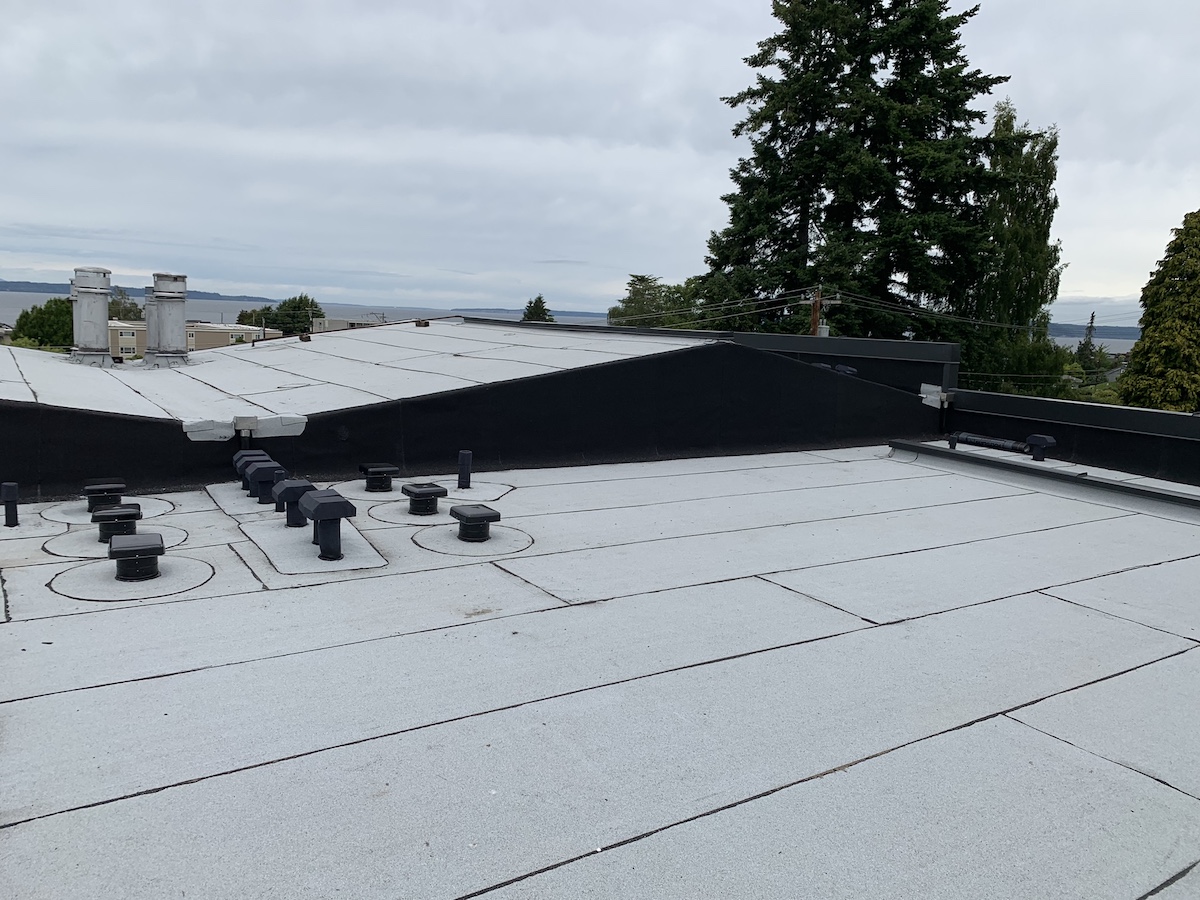
Small and penetration-dense commercial roofs: Buildings with high penetration density, small medical offices, restaurant facilities with multiple exhaust flues, older commercial buildings with original penetration arrays that have been added to over decades, are candidates for mod-bit because the multi-ply system can be detailed around complex penetration geometry more efficiently than single-ply. When a roof has thirty or more penetrations in under 5,000 square feet, mod-bit's forgiving multi-ply detailing approach reduces labor time and lowers the risk of flashing failures at individual penetration boots.
Cold-storage and temperature-differential applications: Modified bitumen's multi-ply construction tolerates the vapor pressure cycling that develops on roofs over refrigerated warehouses and cold-storage buildings. The vapor drive through a cold-storage roof system is substantially higher than through a standard commercial building envelope, and the multi-ply system is more tolerant of the resulting membrane stress than thin single-ply installations without a properly designed vapor retarder.
Where Single-Ply Has Eclipsed Modified Bitumen for OKC Buildings
Large industrial and warehouse buildings: On the I-40 corridor distribution centers, the Air Depot Boulevard industrial parks, and the I-35 north industrial inventory, mechanically attached TPO installs faster, costs less per square, and carries equivalent or longer warranty terms than comparable torch-down mod-bit. The labor differential on roofs above 20,000 square feet makes single-ply the economically dominant specification. We do not specify mod-bit on large-format industrial roofs when TPO is the better capital decision.
Oklahoma energy code compliance: The 2021 International Energy Conservation Code as adopted in Oklahoma requires cool-roof Solar Reflectance Index compliance on many new commercial roof installations. Standard gray or black granulated mod-bit cap sheet runs SRI values of 0 to 20, substantially below the code threshold. White-granule SBS cap sheet is available and code-compliant but is more expensive and less commonly stocked than standard white TPO, which achieves SRI 78 to 104 without any special specification. For new construction where energy code compliance is a permitting requirement, TPO or PVC is generally the path of least resistance.
Long-term warranty requirements: The maximum standard manufacturer warranty on modified bitumen systems is 20 years, and most commercial mod-bit programs are structured around 15-year terms. TPO and PVC carry 20-year and 25-year no-dollar-limit options. For building owners making a 20-plus-year capital commitment and a single warranty investment, single-ply wins on warranty term and warranty ceiling.
Torch-Down vs. Self-Adhered, Selecting the Right Application Method
Torch-applied SBS is the standard production method for most Oklahoma City commercial mod-bit work. It is faster per square than cold-applied, bonds reliably to granulated base plies, and the torch-applied seam is the most durable field joint available in modified bitumen. Hot-work permits are required in Oklahoma City and most surrounding municipalities, the City of OKC's permit process typically takes three to five business days for a straightforward commercial roof project.
Self-adhered cold-applied systems use pressure-sensitive adhesive factory-applied to the membrane back face, no torch, no open flame, no hot-work permit. Application is slower and requires careful temperature management (below 45°F, the adhesive does not bond properly and installation must stop). For active healthcare facilities, occupied buildings with sensitive interior operations, or any project where the facility manager has restricted hot-work, self-adhered is the only practical mod-bit option. Oklahoma's spring and fall weather windows are well-suited to self-adhered applications when temperatures stay in the 50 to 90°F range.
Frequently asked questions
Can you recover an existing mod-bit roof with new modified bitumen rather than full tear-off?
Yes, when moisture cores confirm dry insulation and the existing membrane is adhered well enough to provide a stable substrate. A single-ply SBS cap sheet recover over granulated cap sheet is a common project type on the older OKC commercial inventory. Two-ply recover systems provide additional durability on surfaces that are uneven or where the existing base ply shows surface irregularities. Tear-off is required when cores show saturated insulation, we verify with cores before proposing any recover option.
Is torch-down work safe on a building that is still occupied?
Yes, with proper protocol. We pull hot-work permits through the City of Oklahoma City or the relevant municipality, conduct a pre-work safety briefing with the building's facilities manager, and maintain standby fire safety equipment during all torch operations. Oklahoma City and the surrounding municipalities require a post-torch fire watch period, our site supervisor maintains this watch through the required duration on every day of torch-applied work.
What warranty can I get on a new modified bitumen roof on an OKC commercial building?
15-year no-dollar-limit warranties are the most common for two-ply SBS systems from manufacturers with Oklahoma distribution. 20-year no-dollar-limit terms are available on premium SBS cap sheet specifications from Johns Manville and Soprema on qualifying system configurations. All manufacturer warranty programs require documented semi-annual or annual maintenance inspection, the same requirement as TPO and EPDM NDL programs.
How does modified bitumen handle Oklahoma's hail season compared to single-ply?
The multi-ply nature of torch-down SBS systems provides reasonable resistance to hail impact at the membrane level, but the governing factor for hail-resistance ratings is the cover board below the membrane, not the membrane surface itself. HD polyiso or HD gypsum cover board under a two-ply SBS system qualifies the assembly for FM 4470 Class 1 hail resistance, which is the threshold for insurance premium discount qualification on most Oklahoma commercial property policies. We specify the cover board as part of every mod-bit scope we write.
Next StepRequest a roof report
Get in touch →
Start with a roof walk.
Send the building address, roof concern, and timing. We will help define the next step.
Contact Us