
Attachment Method Selection for Oklahoma City Buildings
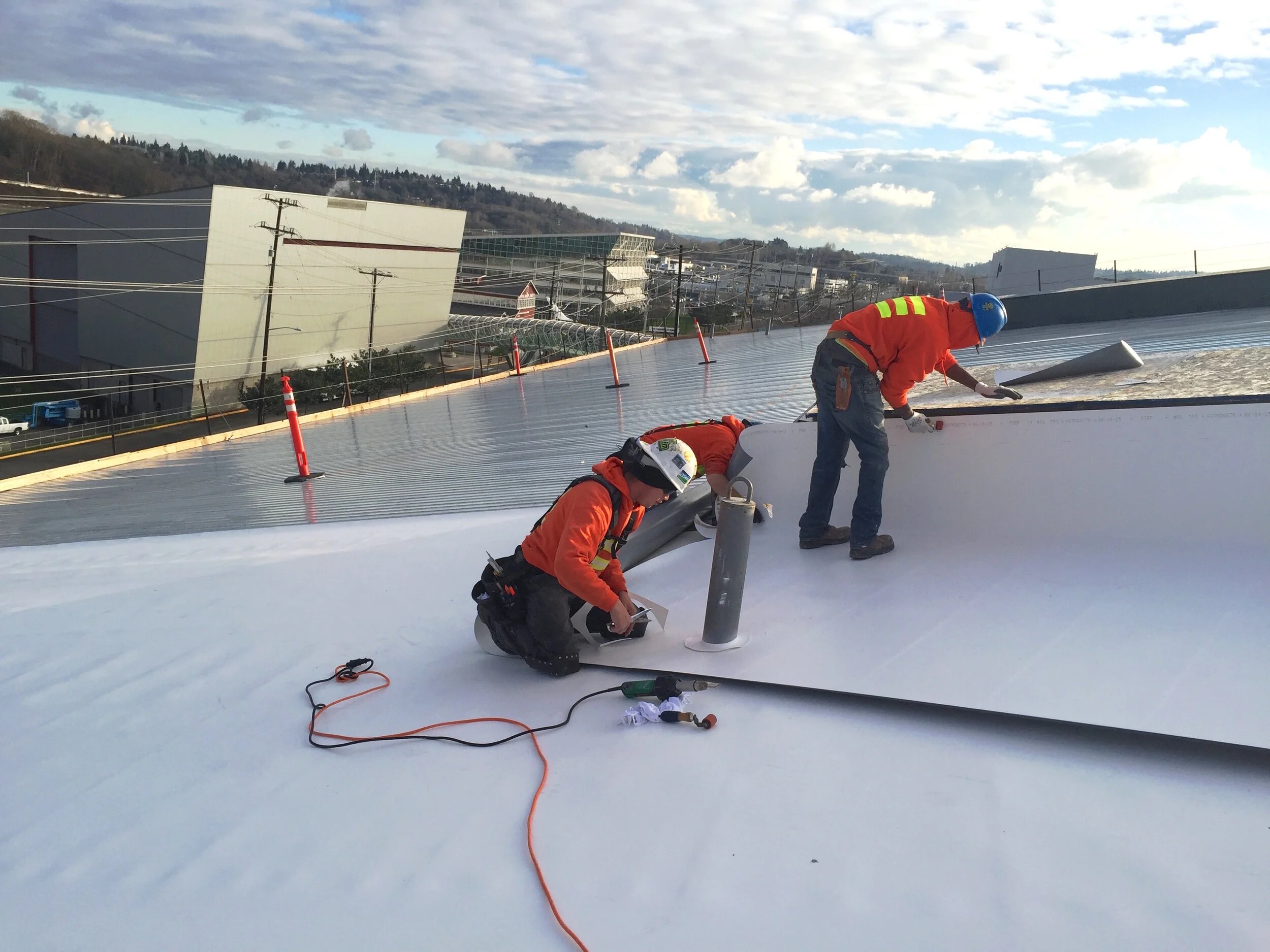
Mechanically attached: Appropriate for most OKC commercial buildings on metal deck substrates in standard wind-exposure categories. The attachment pattern is designed per ASCE 7-22 wind-uplift requirements for the building's actual dimensions, occupancy category, exposure category, and deck type. Perimeter and corner zones always require higher fastener density than the field, the May 3, 1999 Moore EF-5 and the May 31, 2013 El Reno EF-5 produced post-event analysis that consistently identified corner and perimeter fastener under-specification as the leading failure mode on commercial flat roofs in the tornado track. We design corner and perimeter zones to FM 1-90 minimum as a standard practice on OKC buildings, not only when the insurance carrier requires it.
Fully adhered: Required on substrates that cannot receive additional mechanical fasteners, on buildings where the wind-uplift design requirement exceeds what mechanical attachment can deliver at acceptable fastener spacing, and on buildings where membrane flutter noise or aesthetic standards preclude mechanically attached systems. Healthcare campus buildings, particularly occupied medical office buildings on the OU Health Sciences Center and INTEGRIS campuses, frequently specify fully adhered systems to avoid both mechanical fastener penetrations and the airborne membrane flutter that creates noise in occupied clinical spaces. Adhesive selection is system-specific and climate-sensitive, OKC's summer heat requires adhesive application during early-morning windows when substrate temperature is below the adhesive's maximum application temperature.
Ballasted: Loose-laid membrane with washed river stone ballast at 10 to 12 pounds per square foot. No fasteners, no adhesive, gravity holds the membrane down. Ballasted systems are rarely specified for new OKC commercial work because: the structural dead load consumes most of a standard steel deck's live-load capacity, leaving inadequate margin for routine rooftop equipment and maintenance loads; and the ballast itself becomes a hail-compounding hazard during severe storms, where displaced stones can damage adjacent roofing sections. Ballasted systems remain on some pre-1990 OKC commercial buildings but are generally replaced with mechanically attached or fully adhered systems at end of life.
Membrane Selection Within Single-Ply, TPO vs. PVC vs. EPDM
TPO (thermoplastic polyolefin): Default specification for most Oklahoma City commercial buildings without chemical-exposure concerns. Heat- The most economical of the three single-ply membrane types per square foot at comparable thickness.
PVC (polyvinyl chloride): Specified for buildings with chemical exposure, restaurant kitchen exhaust, food processing, dry-cleaning operations, industrial solvent handling. The 25-year no-dollar-limit warranty term from Sika Sarnafil and Versico is the longest standard manufacturer warranty in single-ply commercial roofing. Material cost premium of 10 to 20 percent over TPO is offset by longer warranty term and longer effective service life in chemical-exposure environments.
EPDM (ethylene propylene diene monomer): Thermoset membrane with the longest proven field history in Oklahoma's industrial market. Cold-seamed with adhesive and tape rather than heat-welded, requires specifically trained installation crews using different seam protocols from TPO or PVC work. Preferred for medical facility environments with chemical exhaust concerns and for buildings in extreme temperature applications where EPDM's broad temperature tolerance is a documented advantage. 20-year no-dollar-limit warranty available at 60-mil.
Oklahoma Climate Factors in Single-Ply System Design
Oklahoma City falls in IECC climate zone 3A, hot, humid, which drives cool-roof reflectivity requirements under the Oklahoma-adopted energy code. Standard white TPO and PVC membranes achieve Solar Reflectance Index values of 78 to 104, satisfying code without additional specification. This reflectivity also provides a practical building operating benefit: peak summer cooling loads in Oklahoma City are among the highest in the central United States, and white membrane surface temperatures running 50 to 70°F below dark-membrane equivalents represent a measurable reduction in heat gain through the roof assembly.
Thermal cycling in OKC covers a range that tests single-ply system details at both extremes. Surface temperatures in late July can exceed 165°F on dark or aged membranes. Winter lows during hard freeze events have dropped below zero at the Oklahoma City NWS station. That thermal range cycles through every building joint, parapet, and expansion condition annually. Fully adhered systems must manage thermal movement through expansion joints and properly detailed parapet transitions, buildings without adequate expansion joint spacing on fully adhered single-ply show membrane stress cracking at parapet corners within five to ten years. We specify expansion joints at intervals appropriate for the membrane type and building geometry on every fully adhered project.
Hail-resistance specification is not optional in the Oklahoma City commercial market. Oklahoma ranks among the top five states nationally for documented annual hail frequency, and multiple spring seasons have produced 2-inch-plus stones across Oklahoma County. We specify HD polyiso or HD gypsum cover board on every single-ply installation, not standard-density polyiso, because the cover board specification is what qualifies the assembly for FM 4470 Class 1 or UL 2218 Class 4 hail resistance, and those ratings are what most Oklahoma commercial property insurers require for discount qualification.
Frequently asked questions
How do you determine whether mechanically attached or fully adhered is right for my OKC building?
We need the building location for wind exposure category determination, the deck type (metal, structural concrete, or wood), and the building height. We run the wind-uplift calculation per ASCE 7-22 and FM Global tables against your specific building, assess the deck condition during the inspection walk, and present the cost and performance comparison between configurations in the written scope. You see the calculation and the reasoning, not just a recommendation.
Can single-ply be installed over an existing roof without full tear-off?
Yes, this is a recover installation. It requires dry insulation in the existing system (verified with moisture cores), no more than one existing roof layer already on the deck (Oklahoma Building Code limits roofs to two total layers before tear-off is required), and a substrate level enough for the new membrane and fastener pattern. Many Oklahoma City commercial buildings with aged mod-bit or EPDM systems qualify for single-ply recover, which avoids the tear-off and disposal cost and reduces project time.
What is FM 1-90 approval and do your single-ply systems qualify?
FM 1-90 is a Factory Mutual wind-uplift rating that specifies the assembly's resistance to 90 psf at the roof field, 180 psf at the perimeter, and 270 psf at the corners. It is the minimum FM standard for most Oklahoma commercial property insurance policies. We design to FM 1-90 as a baseline on OKC commercial buildings and document the FM approval number in every project closeout file. For buildings with FM Global property policies that require a higher rating, FM 1-120 or FM 1-150, we design to that standard and document accordingly.
How do single-ply warranties hold up when my building sustains hail damage?
A manufacturer no-dollar-limit warranty covers manufacturing defects and installation failures, it does not cover hail-impact damage, which is a weather event outside the warranty scope. The hail-resistance protection for your building comes from the system's FM or UL hail-resistance rating (which supports insurance claim recovery) and from your commercial property insurance policy. We document the FM or UL rating on every installation, and that documentation is what your insurance carrier needs to verify the system qualifies for the rated coverage.
How do you handle single-ply installation during OKC's spring storm season?
From March through June, we maintain a standing same-day dry-in discipline on every project, no section of membrane is removed without a plan to have that section weathertight by end of day. We monitor Oklahoma Mesonet forecasts and stage production around storm-risk windows. Adhesive and sealant work is not scheduled when rain is forecast within six hours. Rooftop flash flooding from short-duration intense rainfall is common in the spring, and an open deck section in that window creates interior water damage that is far more costly than a one-day production delay.
Next StepRequest a roof report
Get in touch →
Start with a roof walk.
Send the building address, roof concern, and timing. We will help define the next step.
Contact Us