
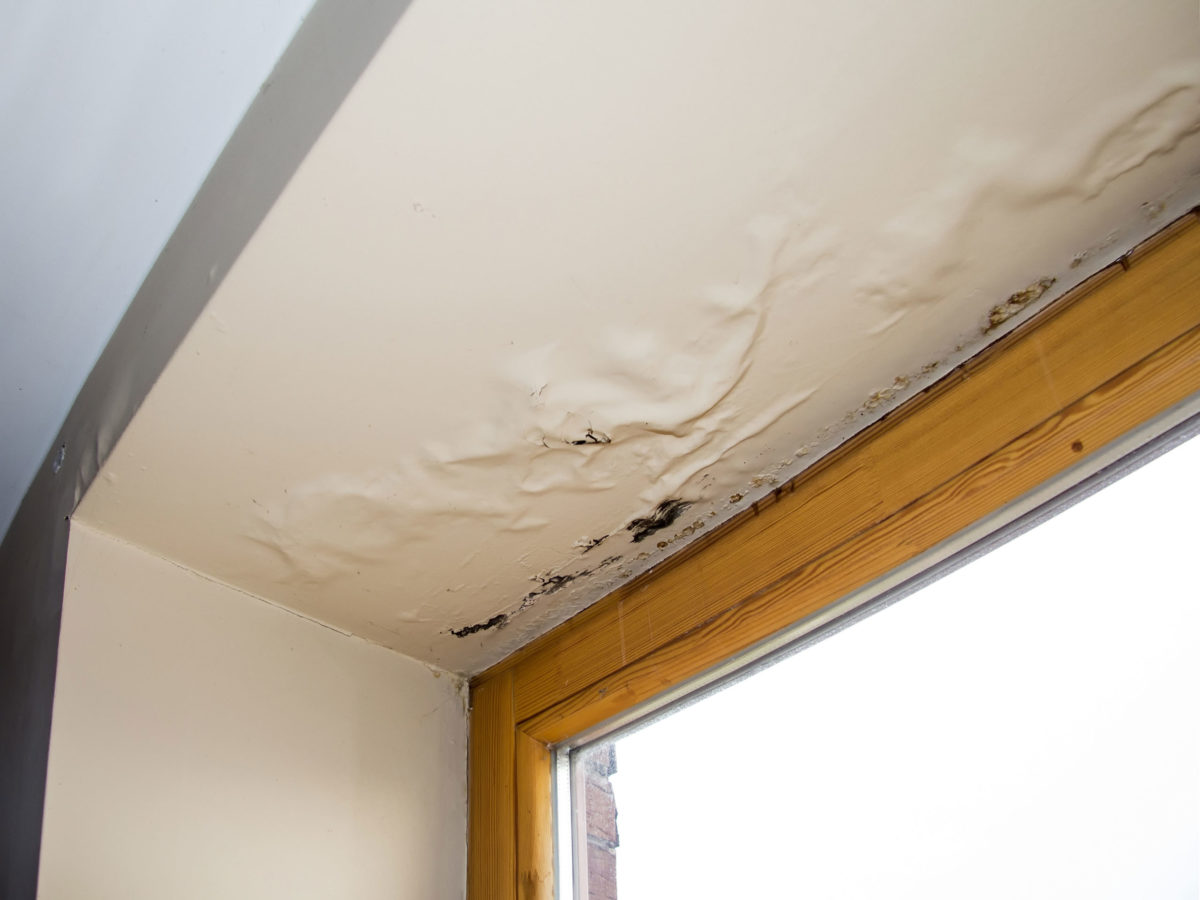
Sometimes the water never came through the top
Owners call us about a stained ceiling or a membrane full of blisters and assume the roof has sprung a leak. On a particular class of building, it has not. The water in the assembly arrived as vapor from inside the building, condensed where it could not escape, and is now destroying the roof from underneath the membrane, no rain required. We see it most where interior humidity runs high all day: cold-storage and food-processing plants in the industrial belt off I-40 and I-240, commercial kitchens around Bricktown and the downtown restaurant corridor, natatoriums and locker rooms at recreation centers, and the laundries and wet-process manufacturers scattered through the metro. The surface symptom looks like a leak. The cause is humidity that had nowhere to go but up.
How interior moisture takes a roof apart
The failure follows a predictable arc, and learning to read it is half the diagnosis. Blisters come first, pockets where vapor pressure trapped beneath the membrane lifts the sheet off its substrate as the roof bakes during the day. Ridging follows, long raised lines tracking the insulation joints as moisture migrates along the seams and pushes the membrane up. Out of sight beneath all of it, the insulation is quietly failing: saturated boards shed their R-value, slump under their own waterlogged weight, and surrender the slope-to-drain the roof was designed around. On a steel deck, the standing moisture starts corroding the deck itself. By the time those surface signs are unmistakable, the wet footprint is almost always larger than anyone guesses, because vapor spreads through an assembly long before it ever shows its hand on top.
Trace it back to the vapor retarder
Oklahoma City lives in a humid-continental climate, muggy, heavy summers and genuine winter cold snaps, and that seasonal swing is the engine driving vapor through a roof. Inside a heated building during the cold months, warm moist air wants to rise and force its way out through the roof assembly. The vapor retarder exists to stop it, and on the buildings we repair, it is routinely in the wrong place, torn up, or simply absent. A retarder installed above the insulation instead of below it, or one punctured during the original build, lets interior moisture ride all the way to the cold underside of the membrane and condense right there in the insulation. Recovering over an assembly like that without correcting the vapor layer just rebuilds the same trap one course higher. We will not do that. If the vapor management is wrong, fixing it is part of the repair, full stop.
Pinpoint the wet insulation before pricing a thing
You cannot fix what you have not found, and the surface symptoms do not line up cleanly with the wet zone underneath. We locate it with infrared moisture scanning. After a sunny day, as the roof sheds heat into the evening, the saturated insulation holds warmth longer than the dry board around it and lights up as warm zones on the thermal image. We mark those zones, then cut cores at representative points to confirm the insulation is truly wet, judge how deep the saturation reaches, and inspect the deck condition beneath it. On any humidity-driven failure, that survey is the spine of the entire scope, it settles whether we are dealing with a contained repair or a roof that is wet from one parapet to the other.
Repair or replace, decided on evidence
The honest answer comes straight off the moisture map. When the wet insulation sits in discrete pockets surrounded by sound, dry roof, we cut and patch: remove the saturated board, dry the area or set new insulation, restore the membrane and flashings over the repair, and resolve the vapor problem that admitted the water. When the survey shows saturation across a large share of the roof, or the deck has begun to rust, a patch is throwing good money after bad and a full replacement is the responsible call. The point of the diagnostic is to ground that decision in evidence instead of a guess, and to make sure whatever we install next does not inherit the same vapor flaw that caused the failure.
Why waiting makes the bill worse
Trapped-moisture damage does not sit still. Wet insulation carries essentially no insulating value, so the building hemorrhages conditioned air through the roof and the HVAC grinds harder and costs more to run, a problem the metro's brutal summers turn expensive in a hurry. Saturation creeps wider season over season, and steel-deck corrosion only accelerates the longer the water leans against it. A roof scanning at fifteen percent wet today can easily read forty or fifty percent by the next inspection, and a repair that started as a manageable cut-and-patch becomes a full tear-off with deck replacement. Catching it early is nearly always the cheaper road.
We fix the cause, not just the blister
A blister patched without addressing why vapor reached the underside of the membrane will be back, guaranteed. So when we repair humidity damage we follow the whole moisture path, the vapor retarder, the interior conditions generating the vapor, and on some buildings the rooftop ventilation or dehumidification that should be carrying that moisture off before it ever reaches the roof. Repairing the membrane and ignoring the source is exactly how owners end up paying for the same repair a second time.
Questions Oklahoma City owners ask about humidity damage roof repair
How do you find moisture you can't see from the surface?
Infrared thermal scanning, flown or walked after sunset when the contrast is sharpest. Wet insulation holds the day's heat longer than dry insulation and reads as warm zones on the image. We confirm every flagged zone with a core sample, which also tells us how deep the saturation runs and whether the deck has started to corrode.
What makes the moisture get trapped inside the roof to begin with?
Usually a vapor-barrier problem paired with high interior humidity. In a heated building, warm moist air pushes up through the assembly; if the vapor retarder is in the wrong position, damaged, or missing, that vapor condenses in the cold insulation under the membrane. Over time it saturates the board, corrodes a steel deck, and lifts the sheet, all without a drop of rain getting through the top.
Can a humidity-damaged roof be repaired instead of replaced?
Often, yes, when the wet insulation is confined to discrete pockets with dry roof around them. We pull the saturated material, replace it, restore the membrane and flashings, and correct the vapor issue. Full replacement becomes the right call when saturation covers a large share of the roof or the deck has corroded. After the survey we hand you the moisture map and a side-by-side of both paths.
What warning signs should I watch for?
Blisters in the membrane, long ridges over the insulation joints, soft or spongy spots underfoot, climbing heating and cooling bills, and interior ceiling stains that don't line up with any obvious leak above them. Any of those on a building that runs humid inside is worth an infrared survey.
Why bother with the vapor barrier, can't you just patch the blisters?
Patching a blister without fixing why vapor reached the membrane only buys a little time before it comes back. Humidity damage is a moisture-path problem, so we address the vapor retarder and the interior conditions driving it. Repairing the roof and ignoring the source is how the same repair gets paid for twice.
Start with a roof walk.
Send the building address, roof concern, and timing. We will help define the next step.
Contact Us