
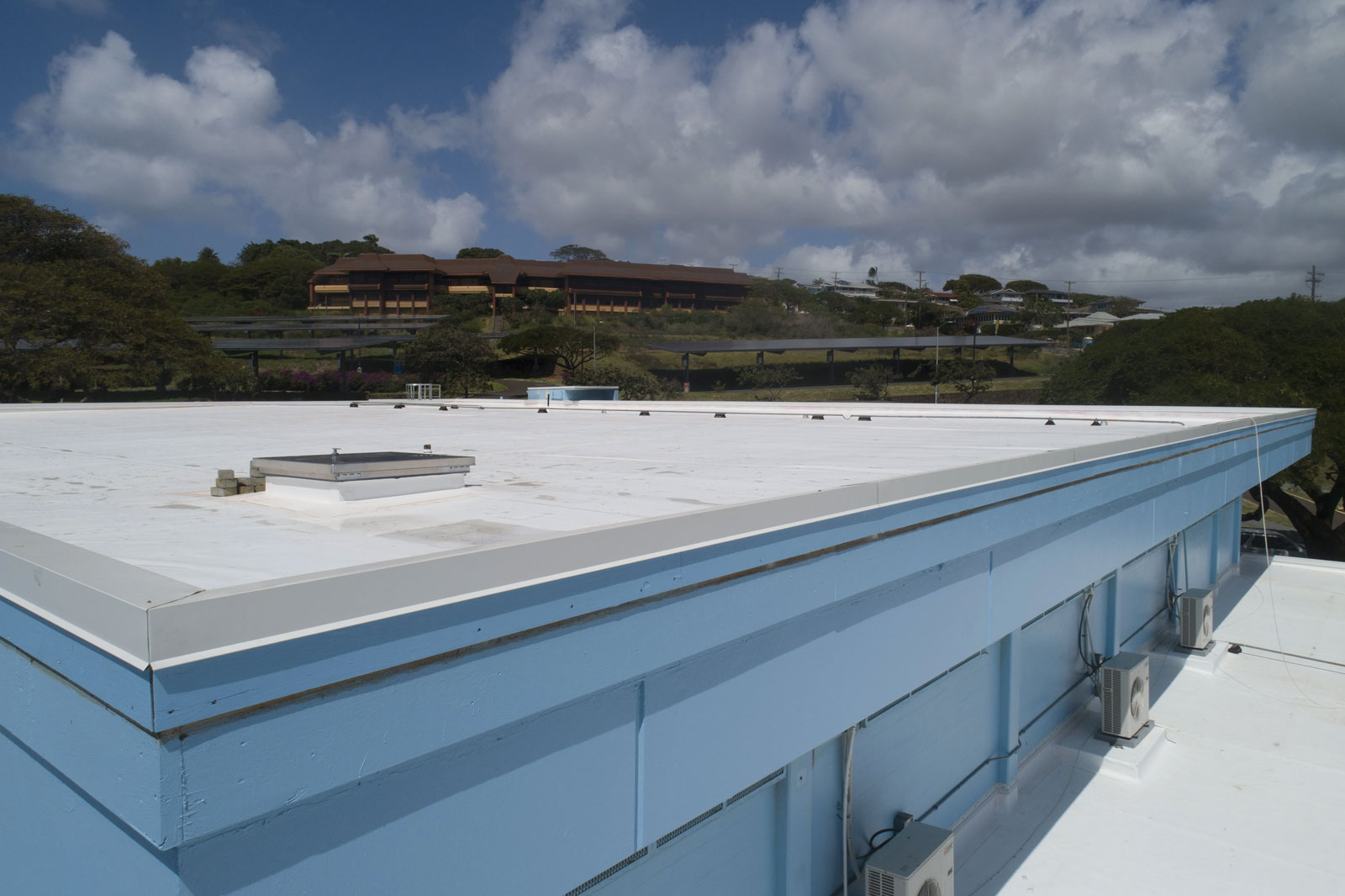
PVC Membrane Specifications, 50-mil vs. 60-mil
50-mil PVC is an entry-level commercial specification appropriate for light-use buildings without significant chemical exposure or high rooftop foot traffic. Most 50-mil systems carry 15- or 20-year manufacturer no-dollar-limit warranty terms. We rarely specify 50-mil on restaurant or food-processing installations, the cost differential between 50-mil and 60-mil is a small fraction of total project cost and the performance improvement is material.
60-mil PVC is the appropriate specification for restaurant buildings, food processing facilities, and any commercial building with documented chemical exhaust exposure. The additional thickness provides substantially better puncture resistance, relevant on restaurant roofs where grease-trap service personnel, HVAC refrigerant technicians, and rooftop ventilation cleaning crews generate more foot traffic than a standard commercial building. 60-mil systems on qualifying configurations carry 20-year no-dollar-limit warranties from standard manufacturers and qualify for 25-year no-dollar-limit warranty from Sika Sarnafil and Versico.
PVC Performance in OKC Restaurant and Food-Processing Environments
Oklahoma City's restaurant district concentration, Bricktown, the Automobile Alley restaurant corridor, the Plaza District, Midtown along NW 23rd, and the growing urban-core dining and entertainment district near the Devon Energy Center, produces high-density rooftop exhaust exposure across a relatively compact geographic area. Most of these buildings are in the five- to twenty-year age range, and the ones that were originally specified with standard TPO are showing the accelerated degradation pattern we see consistently on restaurant-exhaust-exposed membranes: surface chalking within three to five years, seam check-cracking at seven to ten years.
The cost argument for PVC on restaurant buildings is a lifecycle calculation, not a per-square comparison. A TPO roof on a high-volume kitchen exhaust building runs an effective service life of ten to twelve years before seam failures and membrane brittleness require replacement. A PVC roof on the same building carries a 25-year warranty. Two TPO cycles over twenty-five years, each requiring full tear-off and installation mobilization, cost substantially more than one PVC cycle at a modestly higher initial material cost.
Oklahoma City's I-40 west industrial corridor includes food processing operations, animal processing facilities, and agricultural commodity storage that produce chemical exposure profiles at the industrial scale. We assess each of these buildings individually, the specific exhaust chemistry and its concentration on the roof surface determines whether 60-mil PVC is the correct specification or whether another system is more appropriate given the specific chemical environment.
Chemical Exposure Applications Beyond Restaurants
Automotive and industrial: The Tinker Air Force Base adjacent industrial corridor along Air Depot Boulevard and SE 59th Street includes automotive, aerospace component, and parts-washing operations whose solvent and cleaning-chemical exhaust affects rooftop membranes. PVC handles a broad range of industrial solvents and cleaning chemicals, though we confirm the specific chemical inventory before finalizing the membrane specification.
Dry-cleaning facilities: Perchloroethylene, the primary solvent in conventional dry-cleaning operations, is destructive to standard EPDM and degrades some TPO formulations over time. Any commercial building with a dry-cleaning tenant whose exhaust vents directly to or near the roof surface requires PVC or a PVC-compatible coating over the existing membrane. This specification needs to be in place before the tenant takes occupancy, not after.
Pharmaceutical and biotech: Biomedical research facilities associated with the OU Health Sciences Center and private biotech operations in the OKC metro produce laboratory fume hood exhaust and solvent vapor that concentrates on the roof surface. PVC's broad chemical resistance profile makes it the conservative specification for these environments, and the 25-year warranty term aligns well with the long-term tenancy patterns of institutional and research facilities.
Frequently asked questions
Is PVC significantly more expensive than TPO or EPDM for an OKC commercial building?
PVC material cost runs 10 to 20 percent higher than comparable-thickness TPO per square foot. On a 20,000 sq ft installation, the material cost premium is approximately $3,000 to $6,000. On a restaurant or food-processing building where PVC carries a 25-year warranty versus a 10 to 12-year effective life on standard TPO, the lifecycle cost comparison favors PVC by a wide margin. We present the lifecycle cost calculation in our scope proposals, not just the initial installed cost.
Can PVC be installed on a restaurant that is still operating during the work?
Yes. PVC installation uses hot-air welding, no open flame, no torch. The primary coordination issue on occupied restaurant projects is scheduling around service hours. We prefer early-morning installation windows (before the lunch service window) and coordinate with the kitchen manager on exhaust system shutdown timing during membrane work directly overhead.
What does the 25-year Sika Sarnafil or Versico warranty actually cover?
The 25-year no-dollar-limit warranty covers labor and material costs to repair or replace warranted system components that fail due to manufacturing defect or installation failure within 25 years of the warranty issuance date. It does not cover damage from building modifications, unauthorized penetrations, or failure to maintain the system per the documented inspection requirements. We close out every PVC project with the manufacturer's field inspection and include the warranty document in the closeout package.
How does PVC perform under Oklahoma's hail conditions?
PVC's impact performance depends primarily on the substrate below the membrane, the cover board specification carries the hail-resistance rating, not the membrane surface alone. We specify HD polyiso or HD gypsum cover board on all OKC PVC installations, which is what qualifies the assembly for FM 4470 Class 1 or UL 2218 Class 4 hail resistance. Oklahoma's documented hail frequency makes this cover board requirement standard on every project we write, not an optional upgrade.
Next StepRequest a roof report
Get in touch →
Start with a roof walk.
Send the building address, roof concern, and timing. We will help define the next step.
Contact Us