
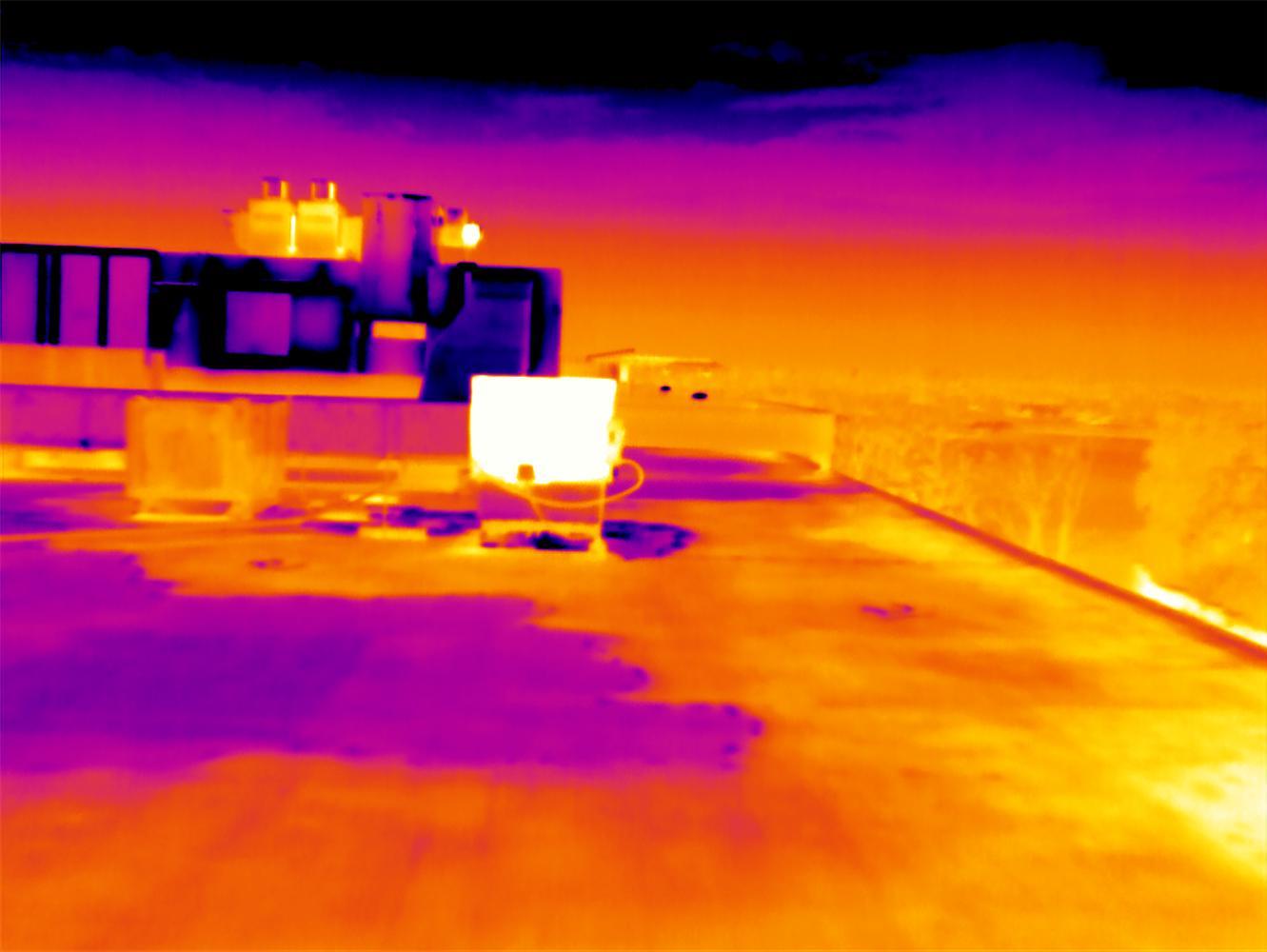
When Infrared Scanning Is Appropriate
Pre-recover decision: Before committing to a recover versus full replacement on an aging roof, an infrared scan tells you how much of the existing insulation is dry and recoverable. If less than 25% of the roof reads wet, recover with targeted insulation replacement at wet areas is typically the sound capital choice. If more than 25% is wet, full replacement is the honest scope, recovering wet insulation traps moisture, degrades the new insulation above it, and voids the new system's manufacturer warranty.
Post-hail and post-storm assessment: After a significant hail event or a tornado-adjacent storm, Oklahoma County experiences high-wind and large-hail events most spring seasons, infrared scanning identifies membrane compromise that may not be visible as an obvious surface fracture. Micro-fractures in aged EPDM and TPO from hail impacts that are below the threshold of visible penetration are well-suited to infrared detection, because water entry through those fractures saturates the insulation below before producing an interior signal.
Pre-sale or pre-refinance documentation: Buyers and lenders in the OKC commercial real estate market increasingly request infrared moisture scan reports as part of commercial roof due diligence. We produce signed, dated scan reports with thermal images and a written moisture boundary summary appropriate for lender and buyer review.
Warranty investigation: When a building owner believes a roof is leaking and a contractor disputes the source, an independent infrared scan produces an objective record of moisture location and extent. We have conducted third-party scans on commercial buildings in the energy-corridor office campuses north of downtown and on the medical campuses in the NW 12th Street corridor.
How We Conduct the Scan
Timing is critical. The scan must follow sufficient daytime solar loading and begin after the surface has started to cool. In Oklahoma City, daytime solar loading from April through October produces the most reliable thermal contrast. July and August produce the highest surface temperatures, but also the most reliable evening differential readings. Winter scans in OKC are less reliable because lower solar angles, frequent cloud cover, and shorter daylight windows reduce the differential loading the scan depends on.
We walk a grid pattern across the roof surface, capturing overlapping thermal frames and recording GPS coordinates at each frame. The thermal images are stitched into a roof plan overlay showing warm suspect-wet zones against the cool dry field. All images are saved with camera metadata intact, date, time, ambient temperature, and camera settings, for the project record.
Core sampling follows the scan: we pull three-inch cores at the centroid of each warm zone identified, plus two control cores in areas the scan read as dry. The cores confirm moisture content and verify the scan's accuracy. On most OKC roofs we have scanned, the thermal read is accurate within roughly one zone boundary, with a false-positive rate on anomalies that is manageable with confirmatory coring.
Limits of the Technique
Infrared scanning reads moisture in the insulation layer directly below the membrane, not in the structural deck, not in the building interior. Deck corrosion or deflection is a visual and probe finding, not a thermal one. This distinction matters on pre-1990 OKC commercial buildings with light-gauge metal deck that may have deck deterioration independent of insulation moisture.
The technique is unreliable on ballasted roofs, on roofs with photovoltaic arrays covering more than 30% of the surface, and on roofs where recent rainfall has saturated the entire surface uniformly, there is no dry baseline to contrast against. Recent heavy rain events during Oklahoma's spring storm season can delay a scan by 24 to 48 hours to allow the surface to dry.
Rooftop HVAC units, of which OKC commercial buildings carry a substantial density, given the cooling demands of a market with 100-degree July and August temperatures, create localized warm zones at their bases that can mask adjacent moisture anomalies. We flag equipment-adjacent anomalies and verify them by core or probe rather than treating them as confirmed moisture findings. A scan report is a planning document, not a warranty of completeness.
Frequently asked questions
How much of an aging OKC commercial roof typically reads wet on a scan?
It varies significantly. Buildings in the NW Expressway and Classen Curve office corridors on original 1990s EPDM or modified bitumen often read 30 to 50% wet, those roofs have been accumulating damage through multiple hail seasons without systematic moisture assessment. Newer buildings on first-generation TPO with good drainage and maintenance histories often read under 10% wet at 15 years of age. The scan tells you where you actually are, which is frequently different from what the last visual inspection implied.
Do you scan during the day or in the evening?
Evening, after sunset. OKC summer surface temperatures are high enough that daytime scanning is unreliable, the radiant heat from the membrane masks the differential between wet and dry insulation. The 45-to-90-minute window after sunset in the warmer months is when thermal contrast is most consistent and reliable.
Can a scan report be used for an insurance claim?
Yes, with the understanding that it documents moisture presence and location, not cause. If you need a report that also establishes cause, distinguishing storm-event infiltration from pre-existing condition, we structure the report to address that distinction and will coordinate with your adjuster on the documentation format they require.
Next StepNot sure if your OKC roof needs replacement or recover? Scan it first.
An infrared scan and a few cores give you the moisture map needed to make a sound capital decision, without opening the roof across the full area.
Request an IR Scan →
Start with a roof walk.
Send the building address, roof concern, and timing. We will help define the next step.
Contact Us