
Insurance-Grade Documentation
A commercial hail claim in Oklahoma requires documentation that establishes three things: that a hail event occurred and affected the specific building location, that the event caused the observed damage, and that the observed damage is distinct from pre-existing conditions. The first is established by NOAA storm reports and the Oklahoma Mesonet weather data network, which provides precise storm-path and hail-size data for Oklahoma County with a density that most states cannot match. The second requires photographs showing hail impact signature, spatter patterns on AC condenser fins, dented pipe boots, fractured granules on modified bitumen, bruising and splits on TPO and EPDM membrane at impact locations.
The third, distinguishing event damage from pre-existing conditions, is where most commercial claims generate disputes. We photograph and describe every area of membrane degradation during our pre-adjuster walk, noting whether the condition is consistent with hail impact (concentrated bruising, radial fracture patterns, clean splits at impact craters) or with age-related degradation (chalking, alligatoring, oxidation, long-line seam stress from thermal cycling). We document both honestly because the adjuster relationship is worth more than any individual claim.
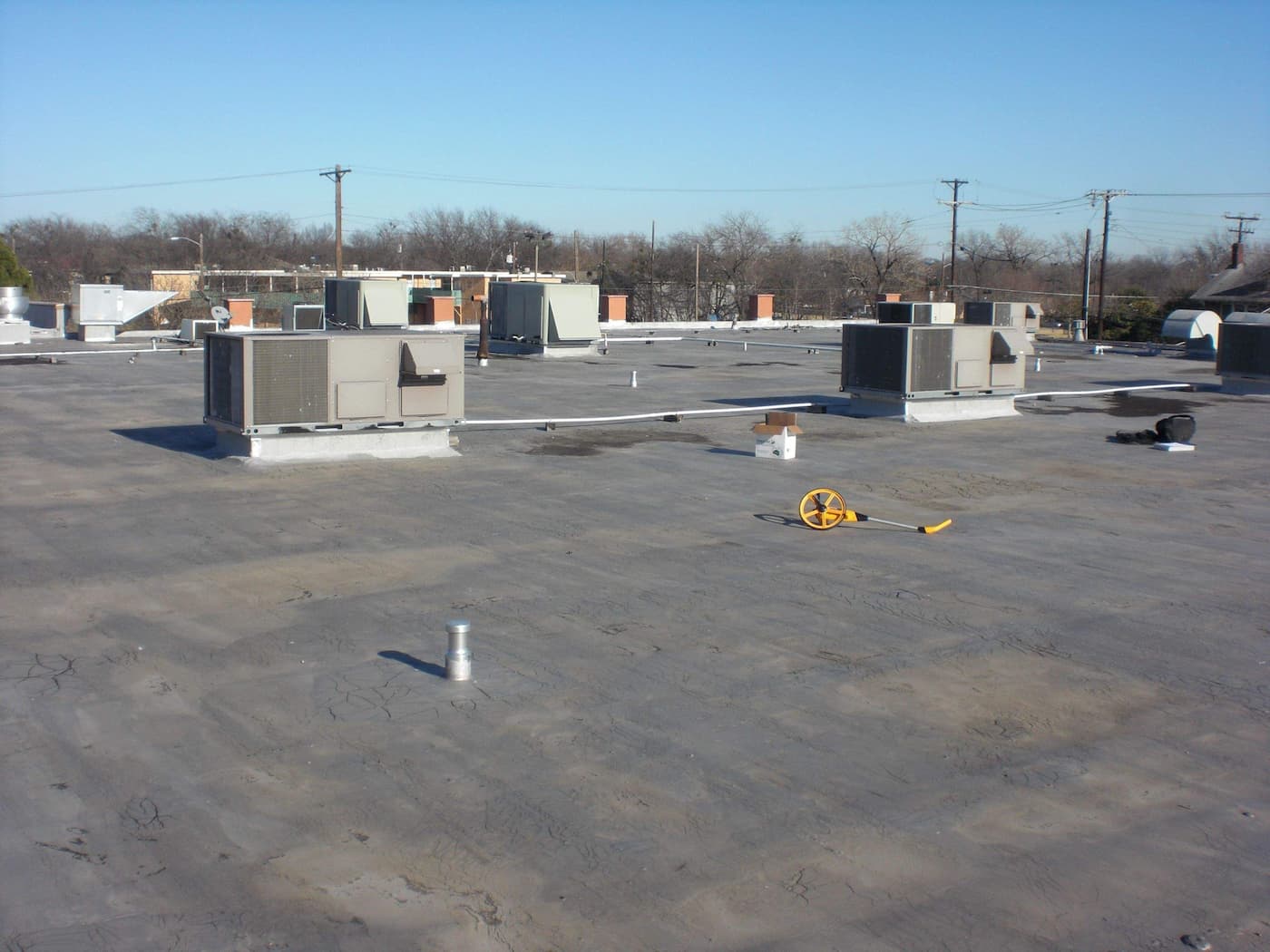
We measure hail density, impacts per 10 square feet, at multiple locations across the roof and use a painted test square to establish a count baseline the adjuster can replicate. Oklahoma Mesonet hail-path data allows us to cross-reference density readings against the storm's documented ground track, which strengthens the event-causation documentation significantly.
Common Hail Damage Patterns on OKC Commercial Roofs
TPO and EPDM membranes: Large hailstones, 1.5-inch diameter and above, which Oklahoma County sees on a documented annual basis, leave visible bruising and occasional fractures through 60-mil TPO, particularly at seam lines where the membrane is bonded to the substrate and cannot absorb impact through deflection. The cover board specification matters significantly: HD polyiso cover board, which we specify on every OKC replacement, reduces penetration depth under hail impact and is the component that allows FM 4470 Class 1 hail-resistance rating. Standard-density board under single-ply does not achieve that rating.
Modified bitumen: Granule displacement is the primary indicator on granule-surfaced modified bitumen. Impact craters without granule coverage expose the base sheet to UV and accelerate membrane degradation at a measurable rate. We photograph exposed areas and compare to non-impacted sections of the same membrane to document the damage differential for the adjuster.
Metal components: Parapet coping caps, metal edge flashings, pipe boots, skylight frames, and HVAC equipment all show spatter damage that serves as hard-surface hail evidence. Adjusters weight hard-surface evidence heavily in Oklahoma commercial claims. We photograph all metal components on every post-hail walk and include them as supporting evidence in the adjuster package.
Ponding acceleration: OKC hail events frequently damage drain covers and partially obstruct drains through debris loading, storm-carried vegetation, gravel displaced from adjacent roofs, debris generated by structural damage nearby. On buildings with marginal drainage in the South Canadian River basin industrial corridor and in the lower-elevation sections of Capitol Hill, a hail event can convert a drain that was functioning marginally into one that fails outright under subsequent spring rainfall.
Working with Adjusters
We schedule adjuster walks at the adjuster's convenience and have our project manager present for the full walk. The person who attends the adjuster walk is the same person who manages the repair, the adjuster's questions are technical, and the answers need to be accurate the first time.
When an adjuster's scope and our scope differ, we document the discrepancy in writing and request a re-walk or a third-party umpire inspection. Most scope discrepancies on Oklahoma commercial claims result from the adjuster not walking the full roof area or not recognizing the impact signature of a specific membrane system. TPO struck by two-inch stones may not show surface fracture on the first day, the bruising is subsurface. We know how to present that information in a way that produces a resolved scope rather than a contested standoff.
We produce all repair documentation in the format the carrier's claim file requires: itemized scope, unit pricing, materials schedule, and post-repair photographs keyed to the pre-repair documentation. This is what allows an Oklahoma commercial claim to close cleanly and without a second mobilization.
Frequently asked questions
How quickly should we get on the roof after an OKC hail event?
Within 48 hours if possible. Most commercial policies have a prompt-notice provision, and dated pre-adjuster documentation protects you against the carrier arguing that damage observed later was not caused by the specific event. We prioritize post-hail walks and can typically get a project manager on your roof within one to two business days of a significant Oklahoma County hail event.
What if our adjuster says the damage is pre-existing?
We document both event damage and pre-existing conditions independently on every roof we walk post-hail. If we have pre-adjuster documentation showing damage that was not present in prior inspection records, that record supports your position. We will walk the roof again with the adjuster and go through the documentation side by side.
Do you work with Oklahoma commercial insurance carriers?
We have worked with the major commercial carriers in the Oklahoma market, carriers operating under Oklahoma Department of Insurance oversight plus the surplus-lines market that is prevalent in Oklahoma given the state's catastrophic storm history. Each carrier has different documentation preferences and we adapt our report format accordingly.
Can you do temporary emergency dry-in while the claim is being adjusted?
Yes. If the roof has active penetrations from large-stone impacts, we install temporary EPDM patch or temporary spray polyurethane foam on the penetrations to stop active water entry while the claim is being adjusted. The temporary repair is documented separately so it does not complicate the permanent repair scope.
Next StepOKC hail event just hit your building? Get on the roof in 48 hours.
We document pre-adjuster conditions, walk with your adjuster, and produce the repair scope and post-repair record that closes the Oklahoma claim cleanly.
Request a Hail Assessment →
Start with a roof walk.
Send the building address, roof concern, and timing. We will help define the next step.
Contact Us