
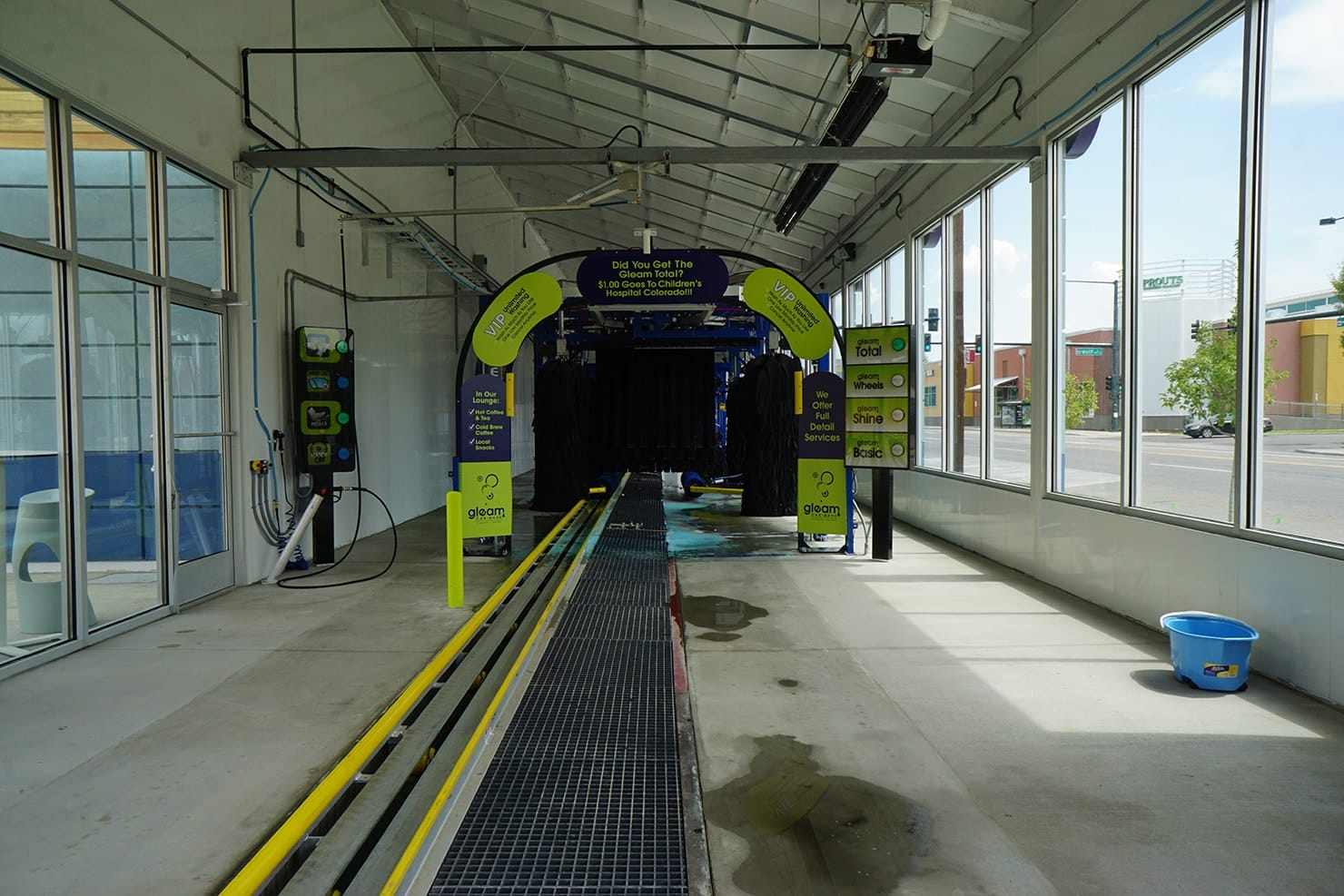
A car wash roof is attacked from the inside out
Most commercial buildings fail at the roof because of what the sky throws at them. A car wash fails the other direction. The damage starts under the deck, where hot detergent mist, tire-shine solvents, drying agents, and a permanent cloud of warm water vapor rise off the tunnel and sit against the underside of the structure all day long. We have opened up Oklahoma City wash bays where the membrane on top still looked serviceable while the steel deck below was scaled with rust and the fastener heads had corroded loose. That is the part of the job a roofer who only walks the surface will miss, and it is the part we look at first.
We work car washes up and down the busy retail strips this city runs on, the express tunnels that line the NW Expressway and May Avenue, the in-bay automatics tucked into convenience-store pads along I-240 and the I-35 frontage in south OKC, and the operations serving the steady commuter traffic out toward Edmond and Memorial Road. Every one of those sites runs a different chemistry program and a different roof exposure, and we price the roof around the building that is actually in front of us, not a template.
Why the wash bay is the hardest roof zone you own
The enclosure directly over the active wash equipment lives in a microclimate that no other part of the property sees. Steam, alkaline detergent particulate, and the thermal swing from hot-water rinse cycles work the membrane and flashings constantly. The three common single-ply systems do not respond to that environment the same way. EPDM and TPO can be chewed up over time by the alkaline detergents and wax compounds in a full-service menu, which is why we lean toward PVC over the tunnel, its plasticizer chemistry holds up far better to that kind of sustained chemical contact. Before we put a number on a bay reroof, we ask which products you actually run and how often, because that answer drives the membrane spec.
Vapor has to have somewhere to go
Tunnel humidity that is not exhausted hard ends up condensing inside the roof assembly. That trapped moisture is what quietly corrodes the deck and saturates the insulation long before you ever see a drip on the floor. We check that the exhaust fans over the tunnel are actually moving the air they were sized for, that the vapor drive is being managed rather than ignored, and that the assembly is built to dry rather than hold water. On a recover, we core the existing roof first, putting a fresh membrane over wet insulation on a car wash is throwing money away.
Different wash formats, different roofs
Oklahoma City has the full range, and the roofing scope shifts with each one:
- Express exterior tunnels run the most aggressive chemical menu and put the heaviest vapor and particulate load on the bay roof. These get our most conservative membrane and flashing spec.
- In-bay automatics on convenience-store sites carry lower vapor exposure but frequently have drainage that ponds water over the equipment bay, a problem we correct with tapered insulation.
- Self-serve bays see intermittent use, but the open-bay design means wind-driven rain and chemical overspray reach flashings that a closed tunnel would protect.
- Full-service operations with detail bays and interior offices need the wash-zone spec on the bays and a conventional commercial system over the occupied side, detailed cleanly at the transition.
Canopies and vacuum structures fail at the connections
On express sites the vacuum canopies and pay-station covers are usually the first thing to leak, and it is almost never the panel itself, it is the connection back to the main building and the drain tie-ins. Those areas take vehicle exhaust, tire-dressing overspray, and the full thermal cycle of outdoor exposure, and the canopy-to-building flashing is where all of that stress concentrates. We treat every canopy transition and drain connection as its own detail with its own fix, rather than rolling it into a generic roof number.
Penetrations need oversized, chemical-rated details
The high-volume exhaust fans pulling steam and vapor off the tunnel sit on penetrations that a standard HVAC curb detail will not protect for long. We flash those with oversized curbs and chemical-tolerant detailing matched to the continuous airflow and the corrosive stream coming out of the bay. Each penetration gets evaluated on its own, a clustered, copy-paste flashing approach is exactly how these roofs start weeping at the curbs.
Keeping the wash open while we work
Car washes in this market run seven days a week through most of the year, and the volume tends to peak on the warm, dry weekends when you least want a crew in the way. We sequence around that. Tunnel-roof work goes into the early-morning or late-evening window when the bay is down, while exterior building and canopy work can usually proceed during the day with traffic control that keeps vehicles clear of the work zone. The point is to keep cars moving and revenue coming in while the roof gets sorted.
What we look at on the first walk
- Underside deck and fastener condition in the wash bay, where chemical vapor corrosion shows up first
- Existing membrane chemistry versus the detergent and wax program actually in use
- Moisture content of the insulation through core cuts before any recover decision
- Drainage and ponding over the equipment bays
- Tunnel exhaust penetrations, curbs, and the canopy-to-building transitions
If you operate a wash anywhere across the Oklahoma City metro and the bay roof is staining, the fasteners are backing out, or you just want a straight read on how much life is left, we will get on the roof, look underneath it, and tell you plainly what it needs.
Common questions about car wash roofing in Oklahoma City
What membrane do you specify over a wash tunnel?
For the tunnel bay itself we favor a 60-mil PVC system, fully adhered or fleece-backed, because PVC stands up to the alkaline detergents and wax compounds far better than TPO or EPDM, and full adhesion eliminates membrane flutter from tunnel air pressure. Over the equipment room, lobby, and vacuum canopies, a conventional TPO or PVC assembly is appropriate.
Does car wash chemical exposure affect the warranty?
It can. Many single-ply warranties carry exclusions for chemical exposure, so before we spec a tunnel system we confirm with the manufacturer that your specific chemistry is compatible and that the coverage holds under those conditions. Some manufacturers offer chemical-exposure warranties, and we identify those options up front.
Can the work be done without closing the wash?
In most cases, yes. We push tunnel-roof work into the early-morning or late-evening close window and handle exterior building and canopy work during operating hours with traffic control, so the wash stays open while the roof gets done.
Start with a roof walk.
Send the building address, roof concern, and timing. We will help define the next step.
Contact Us