
How Sustained Below-Zero Temperatures Damage OKC Commercial Membranes
TPO membrane performance at extreme cold temperatures depends on the formulation's low-temperature flexibility rating, which is specified by the manufacturer and varies significantly across product generations. Early-generation TPO manufactured in the 1990s and early 2000s, which represents a large share of the OKC commercial roof inventory, has lower cold-temperature flexibility than current formulations. At sustained temperatures of 0°F to 10°F, those membranes contract by measurable amounts, and the contraction forces are concentrated at lap seams. Seams where the adhesive bond has already partially degraded from UV exposure and thermal cycling are the first to open.
EPDM membrane behavior at extreme cold is similar but slightly more forgiving in well-maintained systems, because EPDM retains more cold-temperature flexibility than aged TPO. The Uri failure pattern on EPDM roofs concentrated at lap seams with compromised adhesive bonds, at flashings where the EPDM had been bonded to non-compatible materials, and at low areas where ice loading added mechanical stress. EPDM that was in good condition before Uri typically survived without membrane failure, but EPDM systems with prior deferred maintenance showed widespread seam separation.
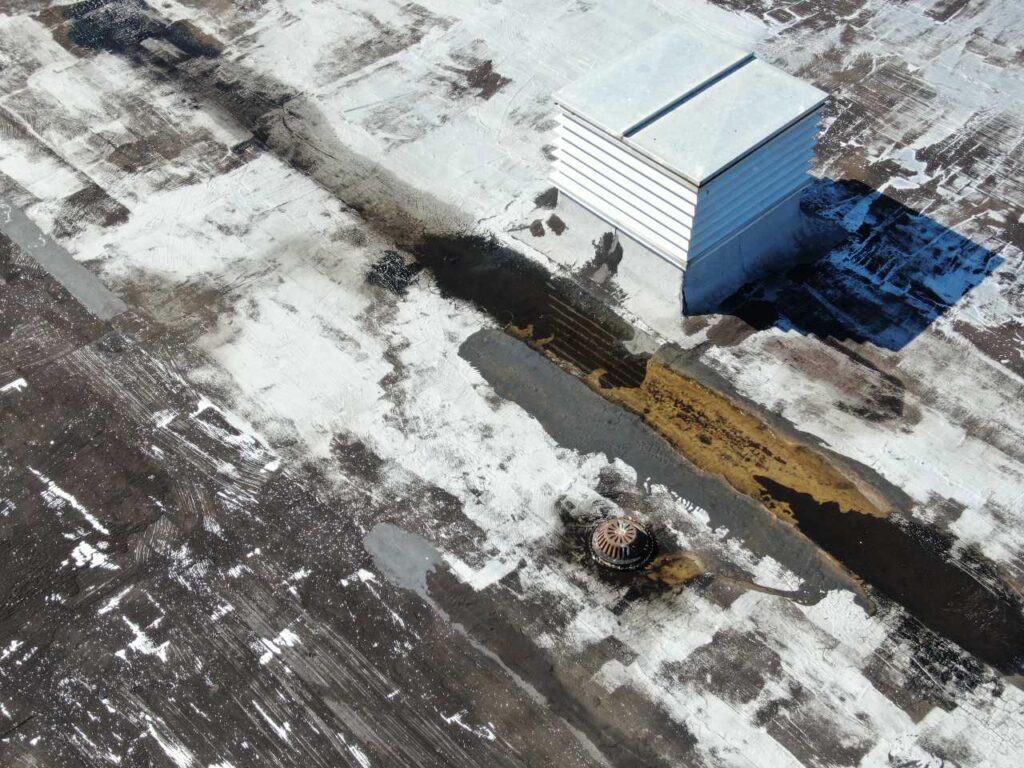
Modified bitumen cap sheets on Oklahoma City industrial and older commercial buildings showed the most widespread Uri-related cracking, because alligatored (surface-cracked) modified bitumen has already lost its cold-temperature flexibility through oxidation. Every alligatored zone on a modified bitumen roof is a potential freeze-crack site. Uri-exposed OKC buildings with alligatored cap sheets frequently required large-scale repair or replacement because the freeze-crack density was too high to address with patch-by-patch repair.
Freeze-Expansion Damage to Insulation and Flashings
The freeze-expansion damage sequence requires pre-existing water in the insulation or at flashing details to produce damage. During the thaw following Uri, buildings that had been slowly infiltrating water through aged flashings before the freeze event experienced sudden and dramatic evidence of infiltration, ceiling tile collapse, wall staining, active water dripping, because the ice that had expanded breach points from hairline cracks to measurable gaps released as liquid water during the thaw.
We see the Uri freeze-expansion residual on roofs we maintain even several years after the event. Buildings that were temporarily patched after Uri but not fully assessed and repaired have the underlying saturation conditions, water still present in insulation, marginal flashing bonds that the freeze expanded but did not fully open, that will produce the next significant leak event during a future winter.
Flashing redetailing after freeze damage requires identifying every flashing bond that was compromised by the freeze event, not just the ones that showed active failure. Flashings that were expanded by freeze stress but did not fully open are at elevated risk of failure during the next Oklahoma winter cold snap, even a normal OKC cold snap of 15°F to 20°F is enough to reopen a freeze-expanded crack that was not fully redetailed after Uri.
Uri Damage Claims and Current Repair Status
Winter Storm Uri generated an unusually large volume of Oklahoma commercial property insurance claims across carriers including Farmers, State Farm, Allstate, and Shelter Insurance. The claim volume and the complexity of the freeze-expansion damage produced some claim settlements that addressed the visible damage without fully addressing the underlying saturation and marginal flashing conditions that the freeze event revealed. We encounter Uri-related repair failures, patches over saturated insulation, flashing reseals over compromised bonds, on OKC buildings we assess for other reasons.
If your OKC commercial building has had recurring leak issues since February 2021 and the prior repairs have not resolved them, the cause may be Uri-related damage that was addressed at the symptom level rather than the source. A current condition assessment can document what is still present from the freeze event versus what has developed since.
For current freeze events, Oklahoma City's normal winter pattern produces single-digit to sub-zero temperatures in brief cold snaps, even in years without a Uri-scale event, the post-freeze inspection protocol is the same: seam condition check on aged TPO and EPDM systems, flashing bond inspection at all parapet and penetration details, and drainage check to confirm no ice damming has produced water accumulation above the drain level.
Frequently asked questions
How do I know if my OKC building sustained freeze damage from Winter Storm Uri?
If your building developed leaks in the months following February 2021, particularly in late spring 2021 when temperatures warmed and previously frozen infiltration began moving, that is a strong indicator. Seam separation on aged TPO or EPDM, cracked modified bitumen in alligatored zones, and flashing details that pulled away from wall bonds are the physical signatures of Uri-related damage. A current condition inspection will document what is present.
Can the Uri damage still be an insurance claim years after the event?
Oklahoma's insurance claim filing deadlines and statutes of limitations apply. We do not provide legal or coverage advice, that question is for your attorney and your insurer. What we can provide is a current condition documentation package that identifies Uri-related damage characteristics, which may support a claim review. Whether that claim is timely and payable is a question for your insurer and legal counsel.
What is the repair scope for freeze-cracked TPO seams on an OKC commercial roof?
Freeze-cracked TPO seam repair requires cleaning and preparing the seam surfaces, applying new seam tape or heat-welding a cover strip over the crack zone, and testing the repair with a probe or pull test. On roofs where the freeze-cracking is widespread, individual seam repairs become impractical and a full membrane replacement over the affected zones is the appropriate scope. We document the seam crack density before recommending repair versus zone replacement.
Should we be doing anything to prepare an OKC commercial roof for winter cold events?
Yes. An annual fall inspection that checks all seam bonds, flashing details, and drain condition before the freeze season is the most cost-effective freeze-damage prevention measure available. Identifying and repairing marginal seam adhesion and marginal flashing bonds before they are stressed by freeze temperatures is substantially less expensive than repairing freeze-caused failures after a cold event.
Next StepFreeze damage or recurring leaks on an OKC commercial roof?
We document the freeze-damage signature, seam separation, flashing expansion, insulation saturation from freeze-thaw cycles, and produce a repair scope that addresses the source, not just the symptom.
Request a Freeze Damage Assessment →
Start with a roof walk.
Send the building address, roof concern, and timing. We will help define the next step.
Contact Us