
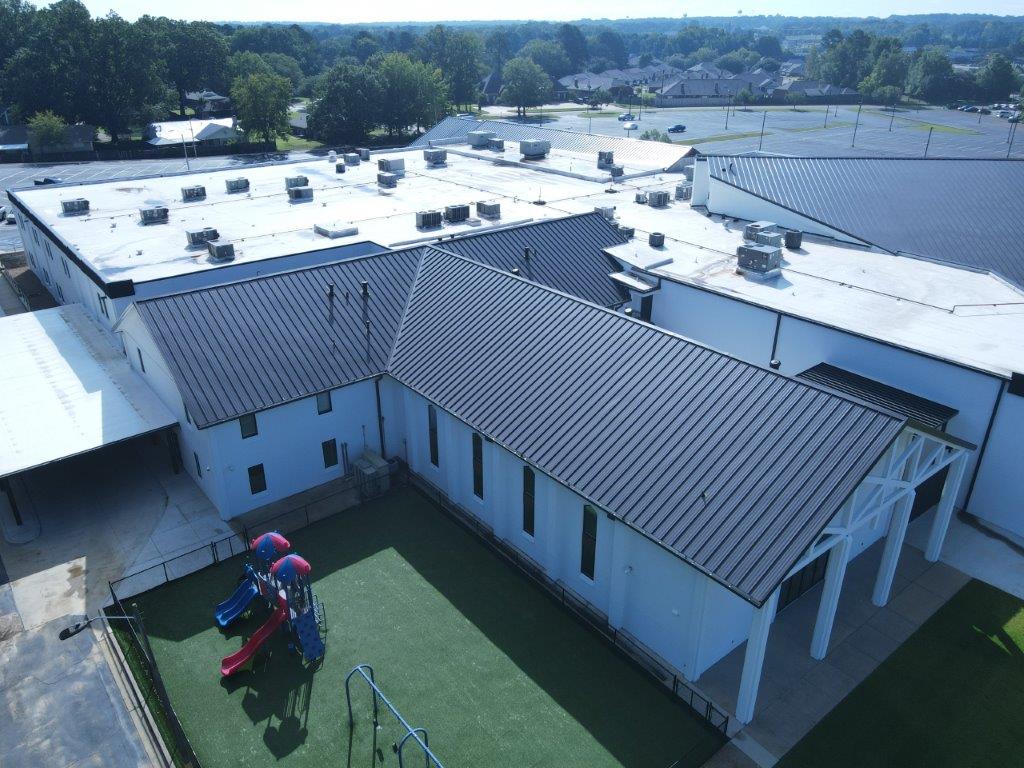
Large Suburban Campus Roofing
The large non-denominational and Baptist campuses along the Memorial Road, I-35, and NW Expressway corridors are the most complex church roofing projects in the OKC market. Campuses that have grown by addition over 20-30 years typically have building sections with different roof ages, different membrane systems, and different drainage designs that have to be assessed individually and addressed in a phased capital plan. We produce a building-by-building condition assessment for these campuses with a recommended capital sequence, highest priority first, with cost estimates for each phase.
Sanctuary buildings on these campuses present a specific protection requirement: a leak above the main worship space during a service event is a facilities management crisis. We assess sanctuary roof conditions with moisture core pulls at any area showing surface distress or interior staining, and we prioritize sanctuary dry-in stability in any phased scope. When we work on sanctuary roofs, same-day dry-in discipline applies regardless of how large the day's section is.
Historic Congregational Buildings
Oklahoma City has a significant inventory of historic congregational buildings in the downtown core, along NW 13th (Paseo Arts District), and in the older commercial neighborhoods of Capitol Hill and Putnam Heights. These buildings, built 1890-1950 in many cases, carry original slate, clay tile, or built-up roofing systems that require specialist assessment before any work begins. Historic congregational buildings often have landmark status or are eligible for state historic tax credits, which affects which roofing systems are eligible and how parapet and trim work must be detailed.
We do not apply a standard commercial replacement scope to historic congregational buildings. The assessment starts with a condition walk and an honest conversation about what the existing system requires, sometimes full replacement, sometimes targeted repair to extend the system another 10-15 years, sometimes a recover that respects the building's architectural character.
Scope Options for Congregational Budget Cycles
We write church campus scopes with layered options because we understand the decision-making structure. Option A is the immediate life-safety response, repairs that stop active leaks and protect interior finishes in the current season. Option B is a 3-5 year stabilization scope that extends the existing system while the congregation builds capital reserves for full replacement. Option C is the full replacement scope with manufacturer warranty. The congregation chooses the option that fits its capital position; we execute it and document it so the next scope can be built on accurate information.
Frequently asked questions
Can roofing work proceed during the week while the church is in use?
Yes. We schedule work around the congregation's weekly programming calendar, no work on Sunday or during identified service events. For campuses with school operations, we coordinate noise-generating work during non-school hours or away from classroom wings. We obtain the programming calendar before mobilization and build the production schedule around it.
Do you provide layered cost options for church finance committees?
Yes. We write scopes with at minimum three options: immediate life-safety repairs, a stabilization scope that extends the existing system 3-5 years, and full replacement with manufacturer warranty. Each option is documented with scope, cost estimate, and expected service life so the congregation can make an informed capital decision.
How do you handle historic church buildings?
We assess historic congregational buildings individually, no standard commercial replacement scope applied generically. We evaluate whether historic tax credit eligibility affects system selection, document existing material types before any work begins, and write a scope that respects the building's architectural character. For buildings with landmark status we confirm review requirements with the Oklahoma State Historic Preservation Office before recommending a system.
What happens if the sanctuary roof leaks during a service?
That is the scenario we work to prevent. We assess sanctuary roof conditions with moisture core pulls in any area showing surface distress or interior staining, and we prioritize sanctuary dry-in stability in any scope. When we are actively working on a sanctuary roof, same-day dry-in is non-negotiable regardless of section size.
Next StepGet a church campus roof assessment in Oklahoma City.
Our project managers will walk every building, produce a condition report by section, and deliver layered scope options sized to your congregation's capital cycle.
Request a Roof Report →
Start with a roof walk.
Send the building address, roof concern, and timing. We will help define the next step.
Contact Us